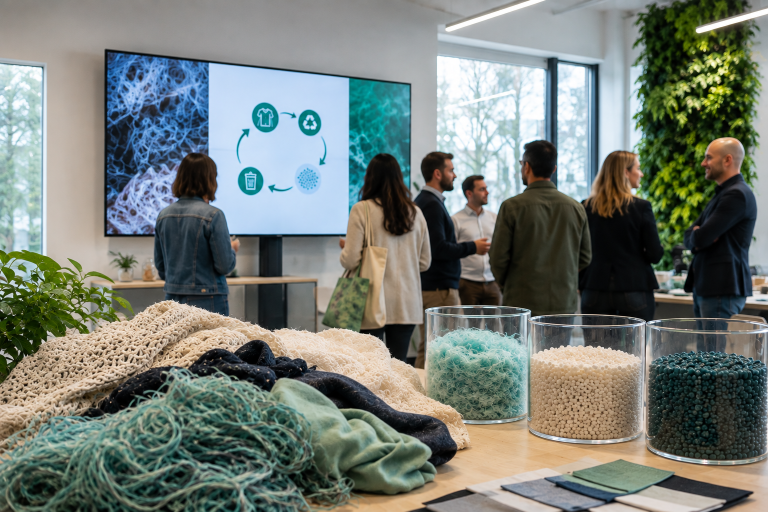
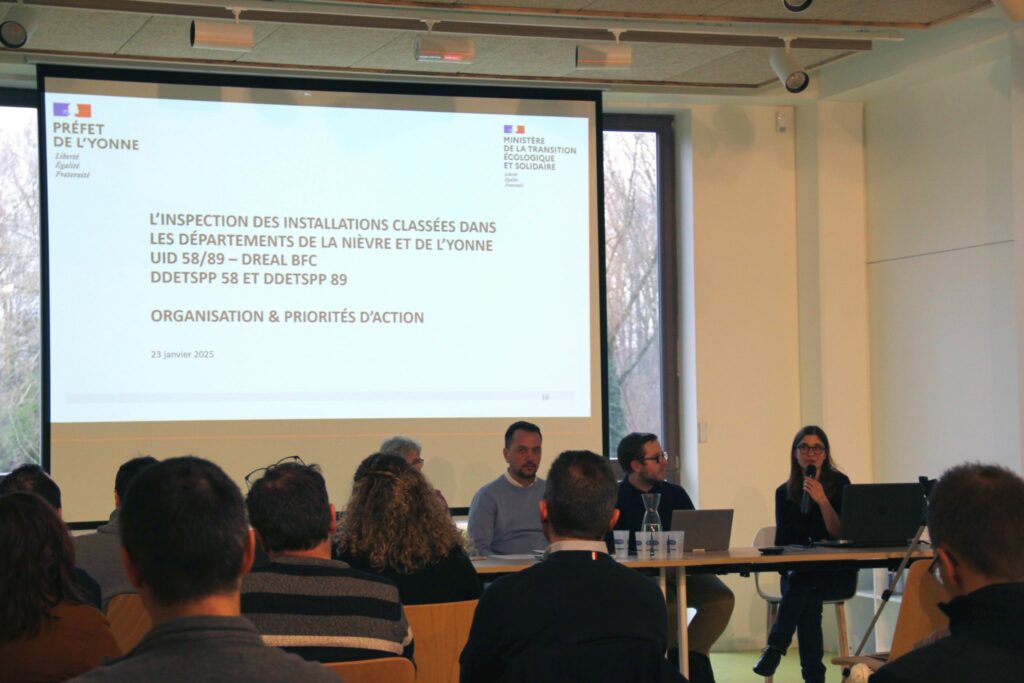
In February 2025, Ecollant took part in a morning event dedicated to Facilities Classified for Environmental Protection (ICPE) at the AuxR_Green Lab Technopole. It was a particularly valuable opportunity in the context of the industrial development of our polyamide recycling technology.
2026 update: Ecollant has become REC and is now pursuing its industrial development from its site in Joigny, Burgundy-Franche-Comté. Managing regulatory and environmental requirements remains an essential component of this industrialisation process.
A Morning Dedicated to ICPE Regulations
In February 2025, we took part in a meeting dedicated to Facilities Classified for Environmental Protection (ICPE), organised at the AuxR_Green Lab Technopole. For a Deeptech company preparing to move from a technology developed in the laboratory to industrial operations, regulatory considerations are essential.
The event enabled us to explore several topics related to ICPE regulations, including:
- the requirements and obligations applicable to industrial facilities;
- inspection priorities for 2025;
- the expectations of the relevant authorities;
- challenges related to preventing and managing environmental impacts;
- the procedures to anticipate when developing an industrial site.
The event brought together representatives and experts from the regulatory and institutional ecosystem, including the DREAL and DDETSPP.
What Is an ICPE?
A Facility Classified for Environmental Protection (ICPE) is a facility that may pose risks or cause adverse effects to the environment, public health, safety or neighbouring areas. French regulations provide for different categories and regulatory frameworks depending on the nature of the activity and the risks or nuisances it may generate.
Depending on the characteristics of the facility, an activity may notably be subject to declaration, registration or authorisation. For an industrial company, determining the applicable regulatory framework and identifying the requirements to be met are therefore important steps before a facility becomes operational.
Why Are ICPE Regulations Important for an Industrial Recycling Project?
Developing a recycling technology does not stop once the process has been validated in the laboratory. When a project moves to a larger scale, new challenges emerge:
- equipment sizing;
- material flow management;
- storage of raw materials and products;
- waste and by-product management;
- resource consumption;
- potential emissions and discharges;
- facility safety;
- risk prevention;
- environmental monitoring;
- regulatory compliance.
These issues need to be incorporated sufficiently early into the design of the industrial project. Environmental regulations are therefore not simply a final-stage requirement. They must be anticipated from the very beginning of the industrial facility’s design.
Environmental Regulations and Scale-Up
Moving from laboratory to industrial scale involves a significant increase in volumes and equipment. A process that operates successfully at small scale must be assessed differently when it is intended to handle industrial volumes.
Scale-up must therefore integrate several dimensions simultaneously: technological performance + industrial safety + regulatory compliance + environmental impact management.
This approach makes it possible to identify potential constraints earlier and understand how they may affect the future production facility. For an industrial Deeptech company, this anticipation is particularly important as it helps secure the stages between the prototype or demonstrator and the industrial facility.
Authorities and Industry: An Essential Dialogue
The meeting at the AuxR_Green Lab also provided an opportunity to better understand the expectations of the authorities and the issues surrounding inspections. These discussions are particularly valuable for companies preparing for industrialisation.
They help identify:
- regulatory obligations;
- documents to be prepared;
- key areas requiring attention;
- requirements relating to the operation of a facility;
- best practices to incorporate into site design.
For REC, dialogue with institutional stakeholders and experts is an important part of preparing our industrial development.
From Ecollant in 2025 to REC in 2026
When we took part in this meeting in February 2025, the project was still being developed under the name Ecollant, and we were actively working on scaling up our technology.
Since then, the project has reached a new milestone. Ecollant became REC in 2026, and the company is now based in Joigny.
Our industrial development continues, with the ambition of developing polyamide recycling capacity for textiles and complex materials. This industrialisation requires technological, economic, industrial, environmental and regulatory considerations to be addressed simultaneously.
Discover REC’s history and development
Responsible Industrialisation
Developing a new industrial technology is not simply about increasing production volumes. It also means designing an industrial facility that is safe, compliant and capable of managing its environmental impacts.
For REC, this requirement is an integral part of our approach. Our ambition is to contribute to the development of an industrial polyamide recycling value chain while incorporating the environmental and regulatory requirements necessary for its operation.
Thank You to Our Local Ecosystem
Meetings with institutional and industrial stakeholders and experts from our region are invaluable in supporting the development of an industrial Deeptech company.
Thank you to Pauline Janny and the CCI Yonne for organising this meeting at the AuxR_Green Lab Technopole and for the quality of the discussions. These exchanges help us better understand the challenges of moving to industrial scale and prepare the next stages of our development.
At REC, we are pursuing our goal: advancing polyamide recycling while building a controlled, compliant and responsible industrial operation. 🌱
📸 Photo credits – CCI Yonne