The transformation of the fashion industry does not rely solely on changing consumer behaviour. It requires an ecological transition involving new technologies, new industrial models and collaboration between startups, manufacturers, institutions and industry stakeholders. Deeptech startups can play a particular role by developing solutions capable of overcoming technological barriers, especially when it comes to recycling complex textiles.
2026 update: This article, originally published under the name Ecollant, has been updated following the company’s name change. Ecollant became REC at the end of 2025 and is now pursuing its industrial scale-up in Joigny.
Why does the fashion industry need to accelerate its ecological transition?
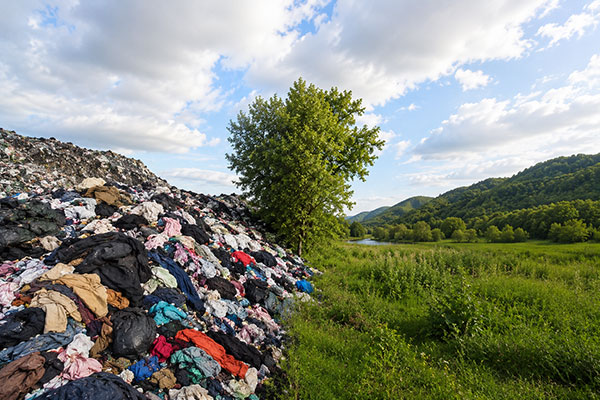
The textile and fashion industry faces several challenges simultaneously: resource consumption, waste generation, dependence on virgin raw materials, emissions throughout production chains and the complexity of product end-of-life management. The transition therefore cannot be limited to producing less or consuming differently. It must also involve rethinking materials, manufacturing processes and product end-of-life.
This means developing:
- high-performance recycled materials;
- industrial processes that are less dependent on virgin resources;
- reuse and repair solutions;
- recycling technologies adapted to complex textiles;
- new supply chains;
- more circular business models.
It is in this context that technology startups can make a particular contribution.
What role do startups play in the ecological transition of the textile industry ?
Startups generally do not have the same industrial resources as large corporations. However, their business models can allow them to explore highly targeted challenges quickly and develop new technological solutions. In the textile sector, these innovations can focus on:
- new materials;
- recycled or bio-based fibres;
- traceability;
- eco-design;
- reuse;
- automated sorting;
- recycling;
- waste recovery;
- reducing resource consumption.
Industrial Deeptech companies have an even more specific role: they seek to turn scientific or technological advances into industrial solutions capable of addressing complex challenges.
Why does recycling complex textiles require new technologies ?
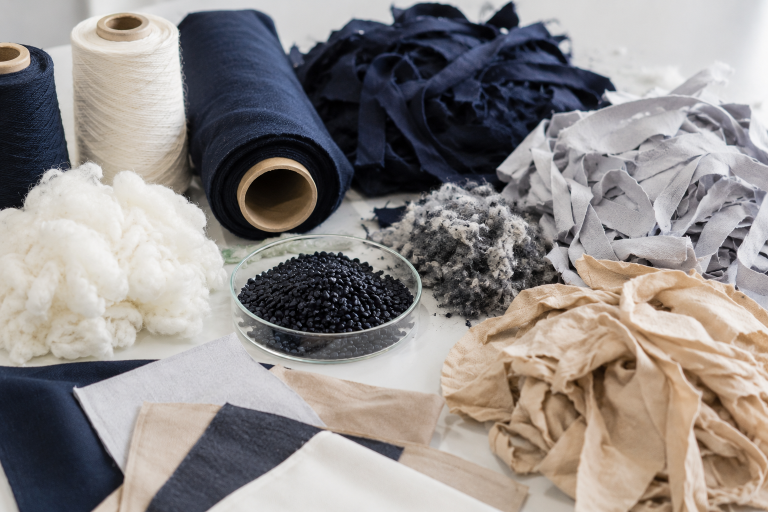
Mechanical recycling can work particularly well when the materials to be processed can be effectively separated and prepared. However, when a textile combines several fibres that are closely intertwined, conventional solutions can reach their limits. The challenge is then to develop a process capable of selectively recovering the material of interest.
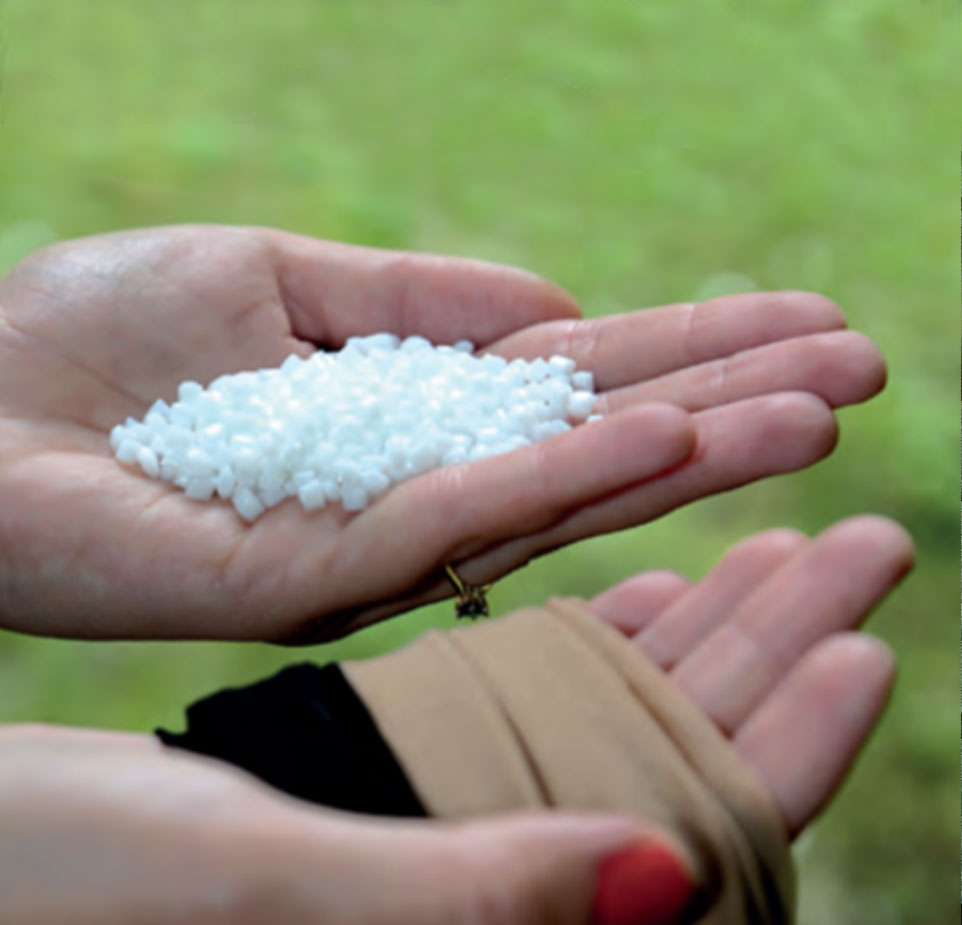
This is precisely the type of challenge that Deeptech technologies can help address. At REC, our technology aims to separate and recover the polyamide contained in complex materials and regenerate it into recycled material for new industrial applications.
Discover the technological challenge involved in fibre separation
From technological innovation to recycled material: driving the ecological transition
The objective of an industrial startup does not stop at scientific proof of concept. A technology must then be: tested → optimized → scaled up → industrialized → commercialized.
This final stage is what notably distinguishes a laboratory innovation from a genuine industrial solution. For REC, the development path includes several stages: research, process development, optimization, industrialization programme, demonstration and the progressive increase of industrial capacity. Today, the company is pursuing this trajectory from its industrial site in Joigny.
A startup cannot transform an entire industry on its own
This is probably one of the most important lessons from our experience. Innovation is necessary, but it is not enough. Building a genuine industrial recycling sector requires connecting different skills and stakeholders. In textile recycling: collect → sort → characterize → prepare → recycle → produce recycled material → integrate it into new products.
Each stage requires specialized partners. At REC, collection is an essential link in this chain. We work with pre-consumer and post-consumer material streams containing polyamide in order to progressively secure the supply of secondary raw materials.
Discover our polyamide collection strategy
From collection to recycled product: the circular model for fashion
Our vision can be summarized as a loop:
End-of-life textile
↓
Collection
↓
Sorting and preparation
↓
Polyamide recovery
↓
Regeneration
↓
Recycled polyamide pellets
↓
New industrial application
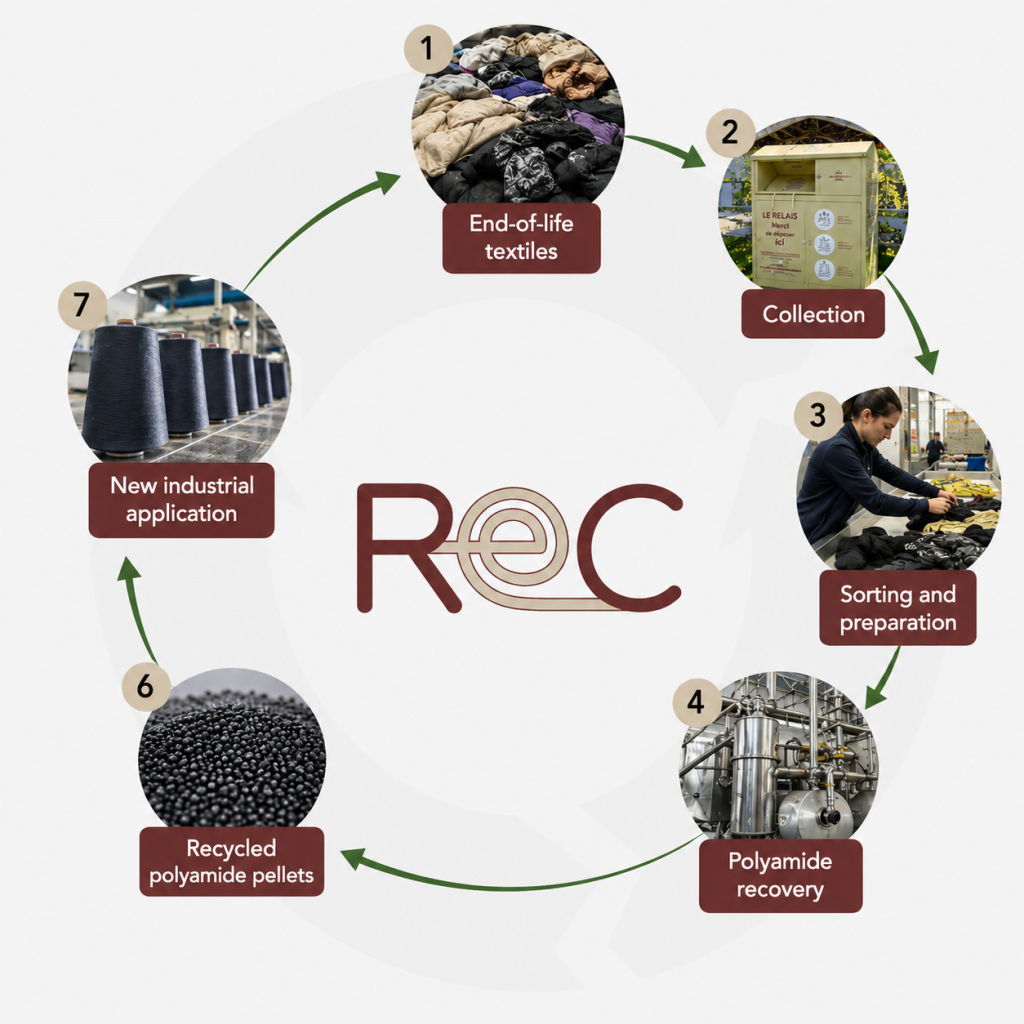
This approach makes it possible to transform waste into a secondary raw material.
REC’s Collection page provides further details on the different pre- and post-consumer material streams and the channels used to structure these flows.
The role of institutions in supporting industrial Deeptech companies
The development of an industrial startup also requires a supportive environment. Public programmes, support mechanisms, competitiveness clusters, technical centres and financing organizations can play a decisive role at different stages of development.
Since its creation in 2019, Ecollant and subsequently REC have developed with the support of various stakeholders from the innovation and industrial ecosystem. This dimension is particularly important for technologies requiring significant investment before reaching full industrial capacity.
From Ecollant to REC: a new industrial stage
When this article was originally published in 2025, the project was still operating under the name Ecollant. Since then, the company has reached a new stage.
Ecollant became REC in 2026, and the company has been based in Joigny since January 2026.
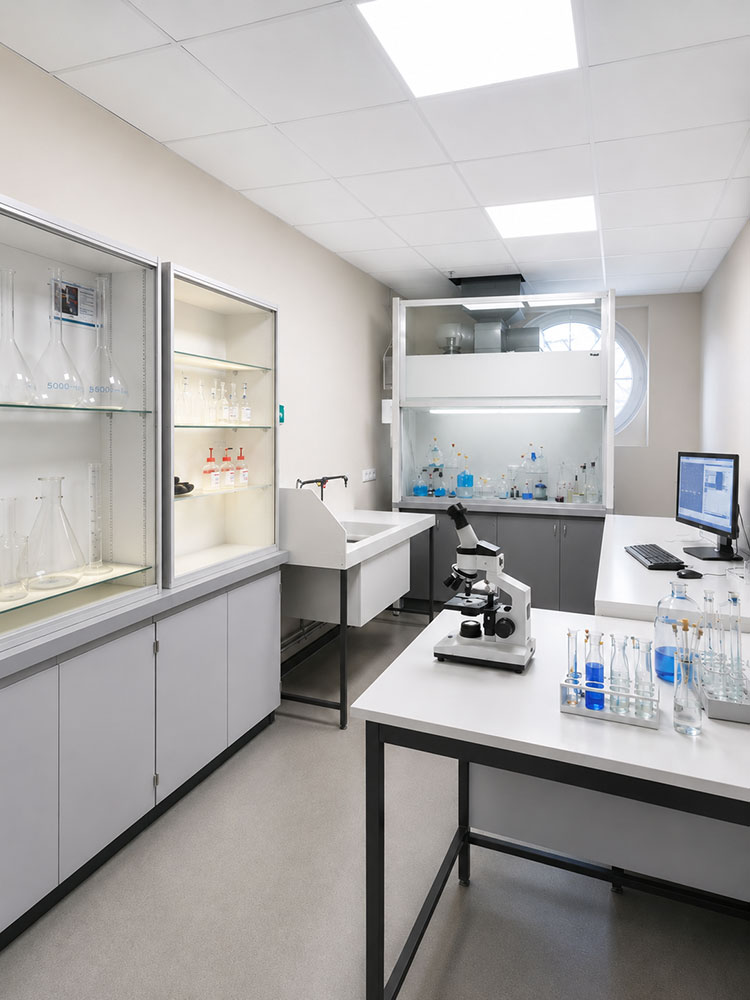
The project is now entering an industrialization phase, with a roadmap that includes a laboratory in Joigny, a 50- to 100-tonne textile waste demonstrator, followed by an initial industrial capacity of up to 5,000 tonnes of textile waste by 2028.
Discover REC’s industrialization roadmap
Innovation only creates impact when it can scale
The ecological transition of fashion will not be achieved by startups alone. But it probably cannot happen without them either. Deeptech startups can help overcome certain technological barriers that currently prevent specific materials or waste streams from being recovered. The challenge then lies in turning these innovations into industrial solutions that can actually be deployed at scale.
For REC, this ambition means developing a technology capable of giving new value to the polyamide contained in complex materials. Our conviction is simple: Innovation creates the possibility, but the industry creates the impact.
And it is by working collectively (startups, manufacturers, brands, collectors, sorters, institutions and consumers) that we can accelerate the transformation of the textile industry.