


Our Vision
Unlocking the Value of Polyamide from Complex Materials
From Ecollant to REC:
Pioneering Tomorrow’s Solutions
Today, Ecollant becomes REC, marking a new milestone in its growth and reinforcing its industrial presence in Joigny. This change of name reflects a strengthened ambition: to fundamentally transform the way textiles are designed, manufactured, and recycled through breakthrough technology and unique expertise in the recycling of complex materials. At the heart of this mission, REC is addressing one of the major challenges of the circular economy: the recycling of textiles made from blended fibers, particularly those containing polyamide. By developing innovative processes capable of extracting and regenerating this material from waste streams previously considered non-recyclable, REC is paving the way for a new generation of circular raw materials and a more efficient use of existing resources.
Polyamide
By the Numbers
Key figures for the French, European, and global markets
France
↑ +24% compared to €1.05 billion
in 2025
Europe
↑ +23% compared to USD 11 billion
in 2025
Global Polyamide Market
↑ +24% compared to USD 46 billion
in 2025
Sources: Market size estimates based on data and industry analyses from MarketsandMarkets, Grand View Research, Mordor Intelligence, ChemAnalyst, and Research & Markets.
A Global Market
Growing Through 2030
The global polyamide market (PA6 and PA6.6) is experiencing sustained growth, driven by demand from key industrial sectors. According to market analyses, it is expected to expand at an annual rate of approximately 4.5% to 5% through 2030.
Contrary to popular belief, textiles are not the largest consumer of polyamide. Today, the automotive industry is one of the leading end markets worldwide, alongside electronics, industrial equipment, packaging, and consumer goods.
Polyamide is valued for its outstanding mechanical properties, heat resistance, lightweight characteristics, and durability. As a result, it is used in a wide range of applications, including automotive components, airbags, electrical connectors, electronic devices, industrial equipment, nets, carpets, rugs, technical apparel, and lingerie.
Several long-term trends are supporting market growth:
- Vehicle lightweighting to improve energy efficiency
- The rapid expansion of electric vehicles
- Increasing electrification of industrial equipment and transportation systems
- Growing demand for more sustainable and circular materials
- The rise of recycled polyamides and low-carbon materials
In this context, access to high-quality recycled polyamide has become a strategic priority for manufacturers facing raw material volatility and increasingly stringent environmental requirements.
At the same time, the European Union is accelerating its transition toward a circular economy. By 2030, textiles placed on the European market are expected to be more durable, easier to recycle, and to contain a growing proportion of recycled content. This regulatory momentum is also extending to other major polyamide-consuming sectors, particularly the automotive and industrial industries.
Europe 2030
Targets
rPA = Recycled Polyamide (PA)
OUR VISION : Maximizing material recovery to transform today’s waste into tomorrow’s resources.
TECHNOLOGICAL CHALLENGE:
FIBER SEPARATION
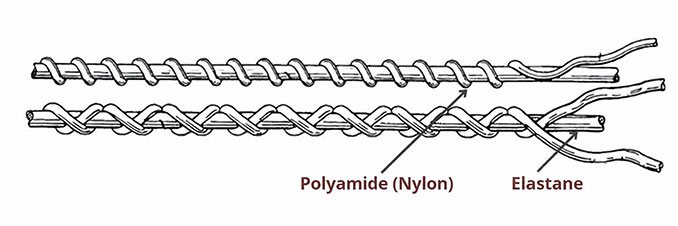
Blended-fiber textiles currently represent one of the most significant challenges in the recycling industry. Tights, stockings, and socks provide a clear example. These products are typically composed of approximately 85% polyamide and 15% elastane.
Their performance relies on a manufacturing technique known as covered yarn technology, in which polyamide is wrapped around an elastane core. This process creates yarns that are strong, soft, and highly elastic, allowing garments to fit the body comfortably while maintaining durability.
However, this complex structure becomes a major obstacle at the end of the product’s life cycle. Because the fibers are tightly intertwined, they cannot be separated using conventional mechanical recycling processes. In addition, the presence of elastane interferes with polyamide recycling, making these textiles extremely difficult, if not impossible, to recover and recycle using existing technologies.
Why Blended Textiles Are Difficult to Recycle : A Technological Challenge
Tights as the First Case Study
Zero Fiber Left Behind
Building a Truly Circular Textile Industry
Today, a significant proportion of end-of-life textiles cannot be recycled. This is particularly true for sportswear, lingerie, tights, and many technical textiles. These products are manufactured from multiple fibers that are intimately blended together, making them incompatible with conventional mechanical recycling processes.
As a result, most of these textiles are still incinerated or landfilled, despite containing valuable raw materials that could be recovered and reused.
To address this challenge, REC has developed a technology capable of separating and recovering the polyamide contained in these complex materials, enabling it to be reintroduced into new production cycles.
By combining research, industrial innovation, and regional development in Joigny, REC is helping build a more circular value chain—one in which textile waste becomes a resource and every fiber has the opportunity for a second life.
This ambition goes beyond recycling alone. It aims to foster a new generation of recycled raw materials that support a more resilient, sustainable, and resource-efficient industry, less dependent on virgin materials.
Our Journey
& Vision
Since its inception, REC has been driven by a strong conviction: transforming the textile industry one step at a time.
Explore the key milestones of our development and discover the ambitions that guide our commitment to building a more sustainable and circular future.
Foundation of Ecollant

Auxerre, France
ADEME Award Winners
Winner of the Ecological Transition Award

Launch of the Collection Program
Team Expansion & Operational Planning
ADEME Award Winners
Initiation of Strategic Research Partnerships



![]()
Process Optimization & Engineering
Industrialization Program Initiated
Name Change : REC
TRL 5

![]()
Joigny
Industrial Demonstrator
50–100 tonnes of textile waste processed
Joigny Plant V1
Capacity to process up to 5,000 tonnes of textile waste by 2028
Plant V2
Capacity to process up to 10,000 tonnes of textile waste
TRL 8
Market Deployment & Industrial Scale-Up
REC 2030
Nothing Is Lost, Everything Is Regenerated
By 2030, REC aims to be recognized as the European benchmark in polyamide regeneration. Our ambition is to create a new industrial resource, produced from yesterday’s waste to meet the needs of tomorrow’s industry.
Every year, millions of tonnes of polyamide-containing products are incinerated or landfilled, despite representing a substantial source of valuable raw materials. REC transforms this environmental challenge into an industrial opportunity through a unique technology capable of recovering and regenerating polyamide from the most complex waste streams.
Our vision is clear: to progressively replace virgin resources with high-performance, traceable, and competitive circular materials, helping build an industry that is more resilient, more sovereign, and more sustainable.
Through this approach, REC does more than recycle a material. REC is helping create a new industrial value chain built on the recovery and regeneration of resources already present in our environment.
Giving Complex Materials
a New Life
REC is developing a breakthrough technology dedicated to the recovery and regeneration of polyamide contained in complex end-of-life materials.
While the company’s initial developments focused on technical textiles, lingerie, tights, and sportswear, the scope of REC’s technology extends far beyond the textile industry. Today, polyamide is widely used across numerous sectors, including automotive, industrial manufacturing, agriculture, fishing, flooring solutions, protective equipment, and technical components.
Through its innovative process, REC can isolate polyamide from complex materials, even when it is combined with other fibers or polymers, and transform it into high-quality compounds that can be directly reused in new industrial applications.
Where conventional recycling solutions reach their limits, REC provides a practical answer to one of the major challenges of the circular economy: recovering value from waste streams that are still largely incinerated or landfilled despite containing a strategic and valuable raw material.
This approach paves the way for the development of a true polyamide regeneration industry, capable of meeting the growing demand for high-performance, traceable recycled materials.
The processes developed by REC are the result of several years of research conducted in partnership with leading polymer research laboratories and recognized technical centers. Following the successful validation of its proof-of-concept phases, the company is now entering a new stage focused on industrial deployment and the scale-up of its production capabilities.
The Responsible Alternative
That Meets Your Performance Requirements
Transition to a more sustainable material without compromising on performance. With REC’s recycled polyamide compounds, you benefit from a reliable, competitive solution that can be seamlessly integrated into your industrial processes.
We deliver consistent quality, secure supply volumes, and full traceability, while significantly reducing your environmental footprint.
Choosing REC means partnering with a company committed to creating value—not only for your products, but also for your sustainability strategy.