What happens to a garment when it can no longer be sold? This question is taking on a new dimension in Europe.
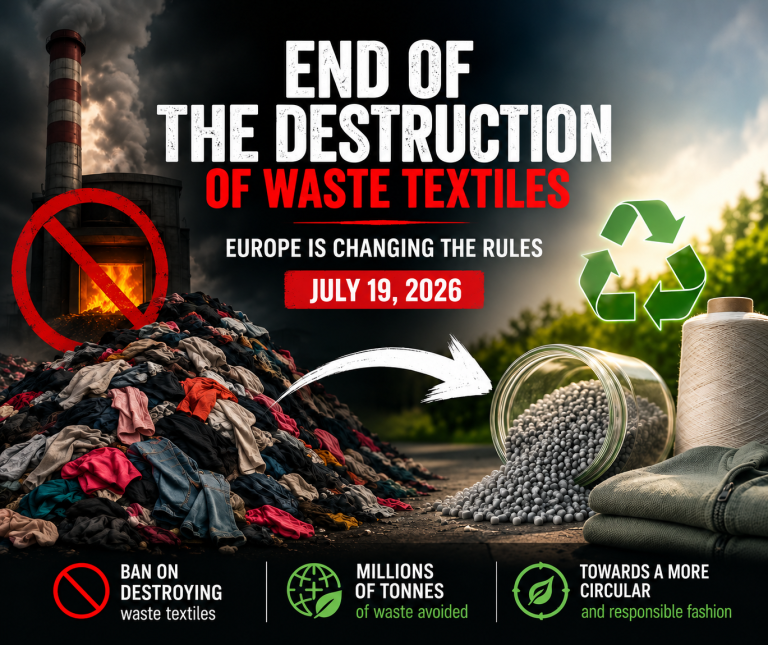
Since July 19, 2026, large companies can no longer destroy their unsold clothing, apparel accessories and footwear in the European Union. This new ban, introduced under the European Ecodesign for Sustainable Products Regulation (ESPR), marks an important step in the transformation of the textile industry towards more circular business models.
The message to the industry is clear: An unsold product should no longer simply be considered waste.
As far as possible, it should remain in circulation, be reused or, when this is no longer possible, allow the materials it contains to be recovered and valorised.
A new rule for unsold textiles
The ban is part of the Ecodesign for Sustainable Products Regulation (ESPR), which entered into force in 2024. This European regulation aims to promote products that are more durable, repairable, recyclable and resource-efficient.
Since July 19, 2026, large companies have been prohibited from destroying their unsold:
- clothing;
- apparel accessories;
- footwear.
Medium-sized companies will also be subject to the ban from July 19, 2030. The regulation also applies to companies established outside the European Union when they place their products on the European market.
However, destruction is not absolutely prohibited. Certain exceptions apply, including products presenting safety concerns, certain damaged products, and other situations defined by the regulation.
The objective is therefore not simply to ban destruction. It is above all to change the trajectory of products that fail to find a commercial outlet.
Sale, donation, reuse… then recycling
The European approach prioritises keeping products in circulation for as long as possible.
The preferred pathway can be summarised as: Sale → new outlets → donation → repair → reuse → recycling.
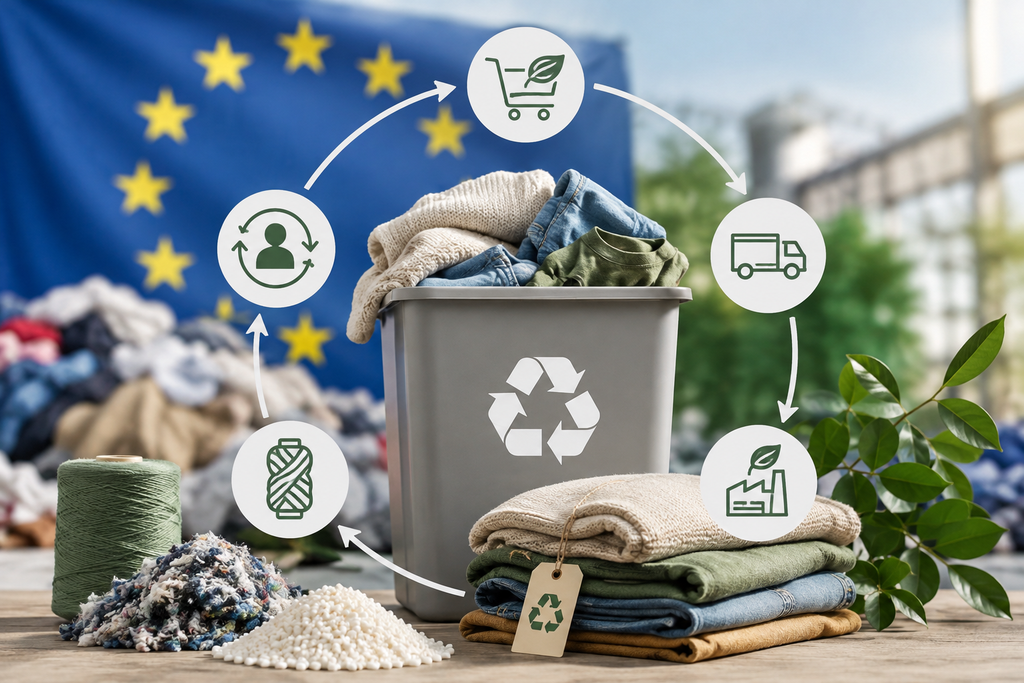
Destruction therefore becomes a much more restricted option. This change may seem obvious, but it represents a significant shift in the way the industry views unsold products.
Because an unsold garment is not simply a product that has failed to find a buyer.
It is also a product that has already required:
- raw materials;
- water;
- energy;
- labour;
- industrial capacity;
- transportation;
- packaging.
Destroying it therefore means losing all of this value, even though the product may never have been used.
Volumes that raise questions
The issue is far from insignificant. According to data cited by the European Commission, 4% to 9% of textile products placed on the European market are reportedly destroyed before finding a user, representing approximately 264,000 to 594,000 tonnes of textiles every year.
This destruction is estimated to represent around 5.6 million tonnes of CO₂.
These figures illustrate a simple reality : The issue of unsold products is no longer simply a question of inventory or commercial management. It is becoming a question of resources.
And when a product can no longer be sold, donated, repaired or reused, another question arises:
What value can still be recovered from the textile?
What if the material itself became the real opportunity?
Some textiles contain materials with significant industrial value. This is particularly true of polyamide, also known as nylon.
It can be found in a wide range of products:
- tights and hosiery;
- lingerie;
- sportswear;
- technical textiles;
- carpets and rugs;
- certain nets and meshes;
- various industrial applications.
The challenge is that this material is not always easy to recover. When polyamide is combined with other fibres, such as elastane, separating the different materials becomes particularly complex.
This is precisely the challenge that REC is working to address.
REC: recovering and regenerating polyamide from complex textiles
At REC, we are developing an industrial technology designed to recover and regenerate polyamide contained in textiles and mixed-fibre materials.
Our technology enables polyamide to be separated from other fibres without depolymerising or altering its molecular structure, and then transformed into recycled material for new industrial applications, notably in the form of flakes and/or pellets.
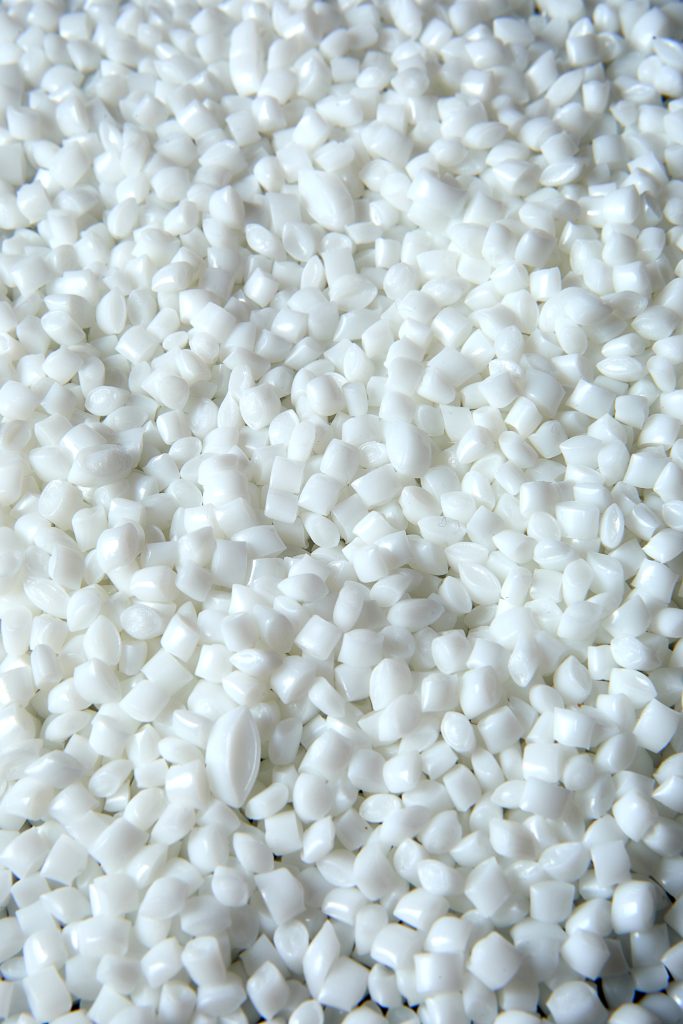
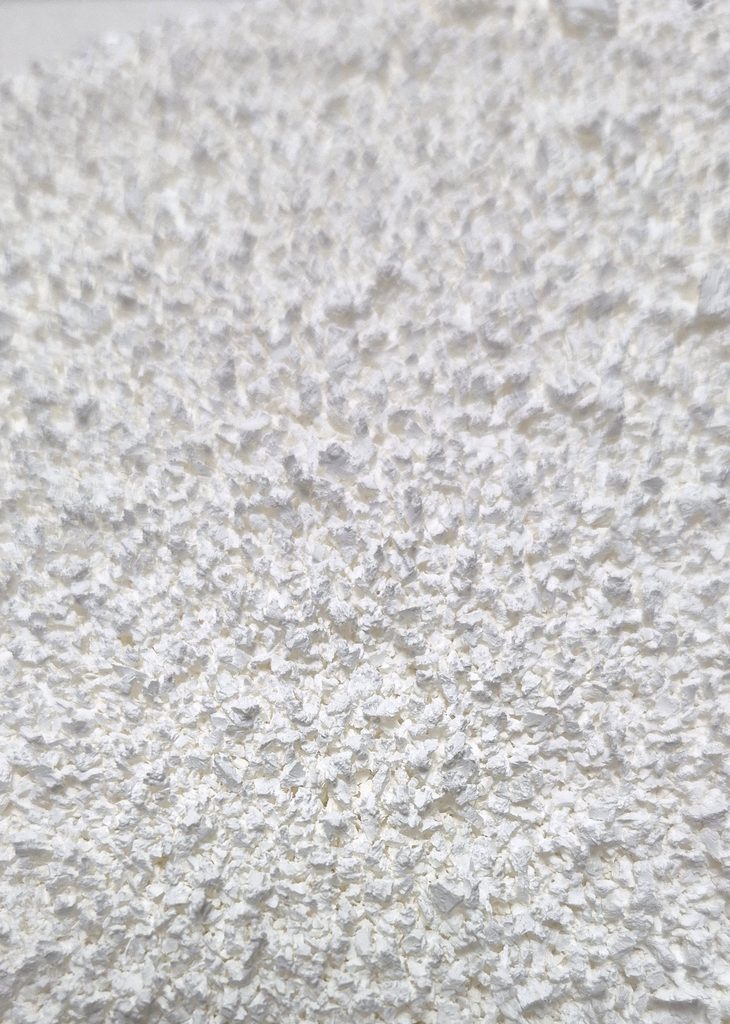
The objective is simple: Preserve the value of a material that has already been produced and enable it to enter a new industrial loop.
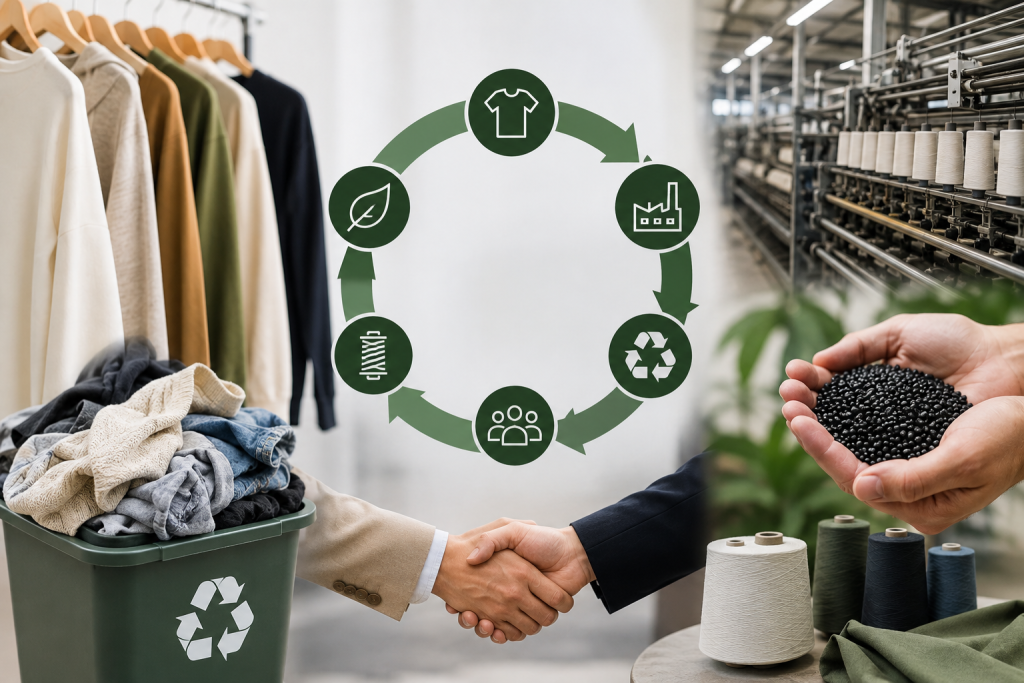
The process can be summarised as follows: End-of-life textile → polyamide recovery → regeneration → recycled material → new industrial application.
Discover REC’s polyamide recycling technology
Regulation is also driving a rethink of product design
The ban on destroying unsold products is only a first step. The ESPR is part of a broader evolution in European regulation: products are progressively expected to be more durable, repairable, recyclable and resource-efficient.
The development of the Digital Product Passport should also make it easier to access certain information about products and their characteristics. This evolution raises new questions for the textile industry:
- How can we design a garment that lasts?
- How can it be repaired?
- How can it be reused?
- How can we identify the materials it contains?
- How can we facilitate their separation?
- And how can we recover their value when they genuinely reach the end of their useful life?
Circularity does not begin when a product becomes waste.
It begins at the design stage.
A regulatory constraint… but also an industrial opportunity
For brands and manufacturers, this new regulation is obviously an additional constraint. But it can also become a driver for innovation.
It encourages the industry to look differently at inventories, unsold products, materials and product end-of-life.
It can accelerate the development of:
- reuse;
- new recovery and valorisation solutions;
- new recycling value chains;
- secondary raw materials;
- more circular industrial models.
And above all, it raises a fundamental question: What should we do when a product can no longer be sold, reused or repurposed?
At that point, the product becomes, above all, a collection of materials that we need to be able to recover and valorise.
Recycling: the final step, but no less important
At REC, we believe that recycling should not replace reuse. Reuse should remain the preferred option whenever possible.
But when a product can no longer be used, we need industrial solutions capable of recovering the materials it contains. This is particularly important for complex textiles, whose composition can currently represent a major barrier to recovery and recycling.
The development of technologies capable of recovering polyamide therefore opens up a new possibility: No longer considering end-of-life textiles solely as waste, but as a source of valuable raw materials.
Towards a more circular textile industry
Europe is changing the rules of the game. Producing and selling a garment is no longer enough.
The industry must also consider its lifespan, reuse potential, repairability and end-of-life. This transformation represents a major challenge for the textile industry.
But it also creates significant opportunities for innovation and the development of new industrial value chains.
At REC, our ambition is to contribute to this transformation by developing industrial solutions capable of recovering and regenerating polyamide from complex textiles. Because when reuse is no longer possible, one question remains:
Can we recover the material rather than lose its value? That is the challenge at the heart of complex textile recycling.
Turning an end-of-life textile into a new raw material for industry means helping to close the loop. And tomorrow, perhaps we will no longer talk about “textile waste”, but about textile resources to be recovered and valorised.
Textile waste can become a resource. It is up to us to develop the technologies and value chains needed to make it happen. ♻️