The European Circular Fashion Trophies represented an important milestone in REC’s history. Winner in 2022 under the name Ecollant, the project met many circular fashion stakeholders and developed collaborations around the collection and recycling of textiles containing polyamide. Looking back at a meeting that helped our project evolve.
2026 update: This article, originally published under the name Ecollant, has been updated following the company’s name change. Ecollant became REC at the end of 2025 and is now pursuing the industrial development of polyamide recycling in Joigny.
The European Circular Fashion Trophies: an important milestone for Ecollant
At the end of 2024, we were pleased to be invited to the final of the European Circular Fashion Trophies, as former winners of the 2022 edition. For us, this event had a particular significance. In 2022, we took part in the final held in Lille with the Ecollant project, which was still at an early stage of development.
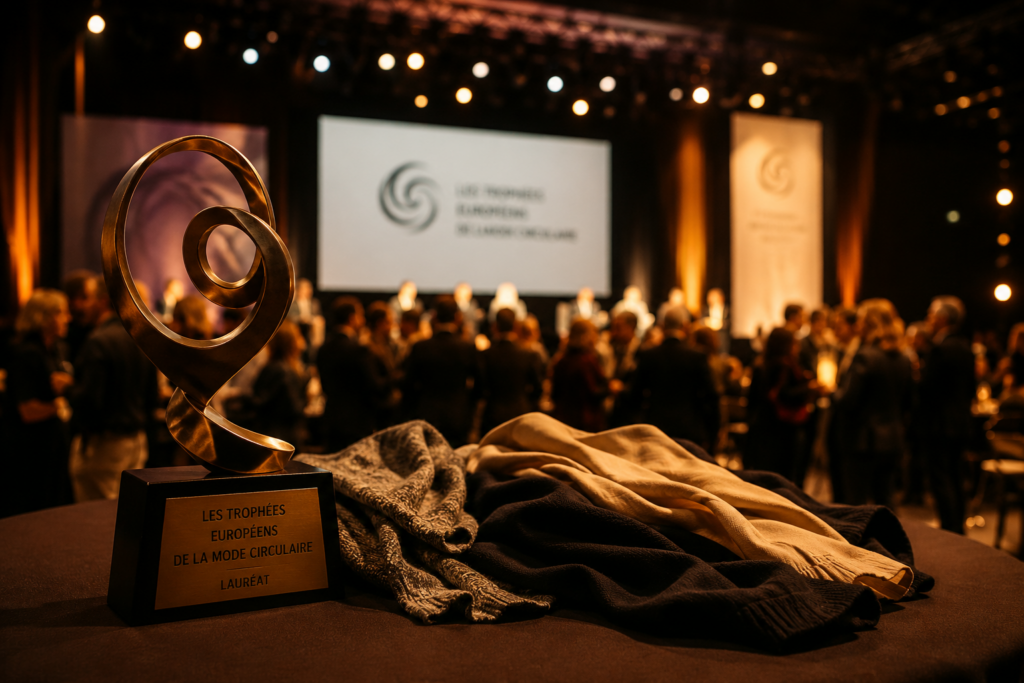
We came to present our polyamide recycling project to an ecosystem made up of brands, startups, companies, circular economy stakeholders and clients. This day allowed us to present our vision, but above all to meet stakeholders whose skills complemented our own.
Why are meetings essential for an industrial startup ?
An innovation never develops on its own. For an industrial Deeptech startup, meetings with ecosystem stakeholders can help identify:
- partners;
- suppliers;
- holders of material streams;
- potential customers;
- users of recycled material;
- awareness-raising partners;
- financiers;
- new collaboration opportunities.
This is particularly true in textile recycling. A recycling technology must be connected to a complete value chain, from textile collection to their transformation into new materials.
This is what we have progressively built over the years.
From meetings to collaboration
Among the meetings held during these events, some subsequently led to concrete collaborations. This was notably the case with companies wishing to raise their employees’ awareness of textile end-of-life issues.
The objective was simple: to enable employees to drop off their used textiles potentially containing polyamide, thereby contributing to the creation of new material streams for the research and development of our technology.
This approach illustrates an important idea: collection can also become a tool for raising awareness of the circular economy.
SNCF Voyageurs: raising employee awareness about textile collection
Among the collaborations developed following these meetings, we notably worked with SNCF Voyageurs Nord. With Tristan Michel de la Morvonnais, who was involved in corporate social responsibility issues, we were able to present the Ecollant project during webinars for employees. The objective was to explain the challenges associated with textile end-of-life and raise awareness of the collection of products containing polyamide.
Employees then contributed to the initiative by setting up internal collection points in their offices. This experience showed us that companies can also play a role in creating material streams and raising awareness of textile circularity.
When collection becomes a tool for raising awareness
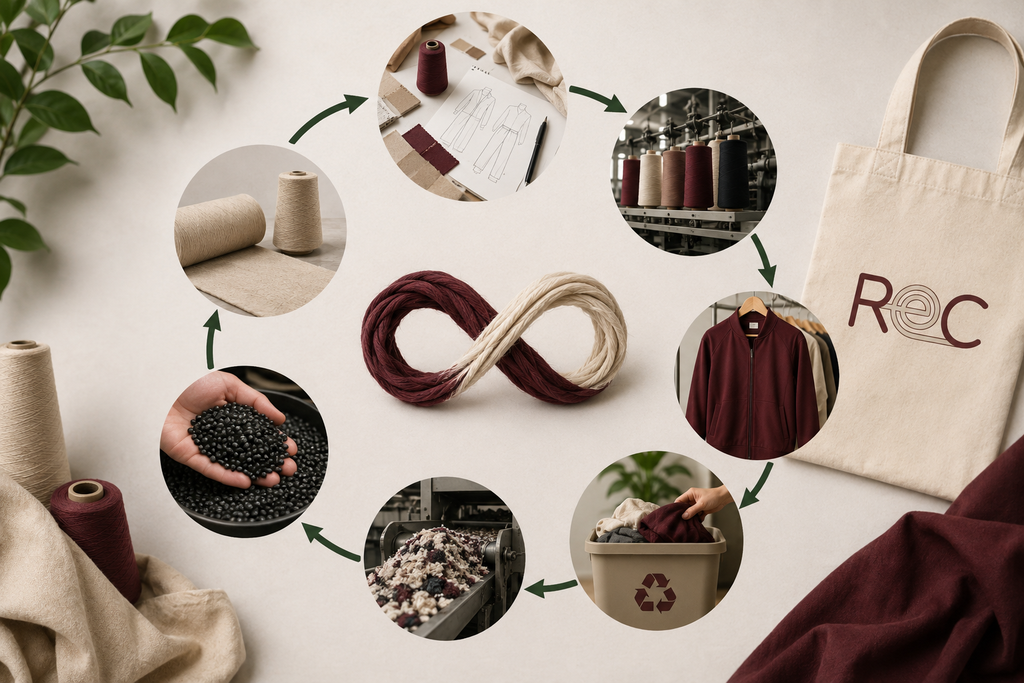
Collection is not simply a logistical operation. It also creates a direct link between citizens, companies and the industrial challenges associated with recycling. When someone drops off a textile they no longer use, they can gradually understand what happens next: collection → sorting → preparation → recycling → new material.
This educational approach is important in changing the way we view textile waste. A garment at the end of its life does not necessarily have no value.
It may still contain materials that can be recovered and reintroduced into new production chains.
Discover how REC collects textiles containing polyamide
An original experience: Voyage en Nord
This collaboration also enabled us to take part in the Voyage en Nord initiative, aboard a train travelling between Paris and Lille. Located in the bar carriage, we were able to speak directly with passengers and raise awareness of the challenges associated with textile end-of-life.
This experience clearly illustrates the complementarity between technological innovation and awareness-raising. Industrial recycling needs high-performance technologies.
But it also needs material streams, and therefore people and organizations capable of contributing to their collection.
Why do brands and recyclers need to work together ?
Today, collaboration between fashion brands and recyclers is a major challenge in developing more circular fashion. Brands know their products, materials, uses and needs. Recyclers develop the technologies needed to give end-of-life materials a second life.
By working together, these stakeholders can consider:
- product design;
- material choices;
- traceability;
- end-of-life;
- recyclability;
- the integration of recycled materials into new products.
Circularity therefore ideally begins at the product design stage, but continues through to the end of its life.
From eco-design to recycling: thinking about the entire product life cycle
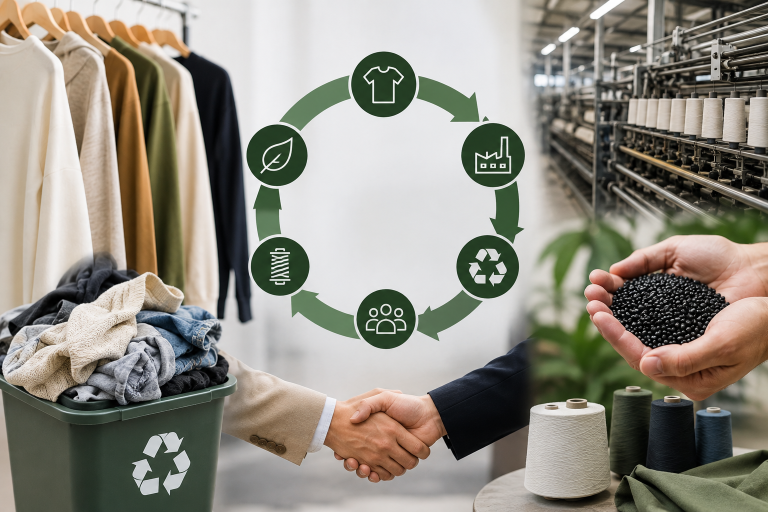
A genuine circular economy requires us to stop considering the different stages of a product’s life separately. We need to consider the entire cycle: raw materials → design → manufacturing → distribution → use → collection → sorting → recycling → new material → new product.
This approach makes it possible to create more efficient material loops. For polyamide, this means in particular developing solutions capable of recovering the material when it reaches the end of its life.
Discover REC’s polyamide recycling technology
An industry that needs to work together
One of the main lessons we have learned over the years is simple: circularity cannot be built by a single stakeholder.
It requires connecting: brands + manufacturers + consumers + collectors + sorters + recyclers + spinners + industrial companies.
Each stakeholder holds part of the solution. Brands can act on product design. Consumers can extend product lifespans and direct products towards the appropriate channels. Collectors and sorters enable material streams to be recovered and prepared. Recyclers develop the technologies needed to transform materials. Finally, industrial companies can reintroduce recycled materials into new production.
The European Circular Fashion Trophies: much more than a competition
With hindsight, the European Circular Fashion Trophies represented much more than a competition. They enabled Ecollant to meet committed stakeholders, compare its project with other initiatives and, above all, begin building relationships that continued beyond the event.
Some meetings led to concrete collaborations. Others simply helped us better understand the challenges facing the industry. All of them contributed to the development of our project.
Building the circular fashion of tomorrow
Developing more circular fashion will likely require greater cooperation between the different links in the value chain. Recycling technologies cannot solve all textile-related challenges on their own. But they are a complementary lever alongside reuse, repair, eco-design and reducing resource consumption.
At REC, we have chosen to contribute to this transformation by working on a specific challenge: recovering and regenerating polyamide contained in complex textiles.
Our conviction remains the same: to create a truly circular loop, we need to think about a product from its design through to its end of life.
And above all, we need the entire industry to work together. ♻️