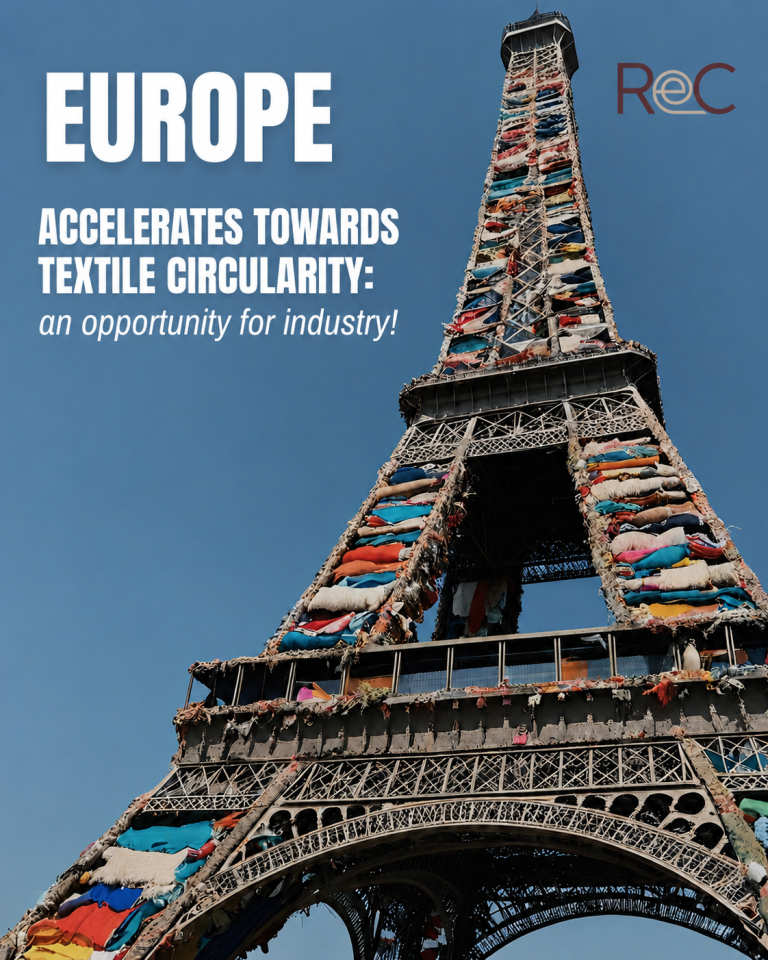
Europe is strengthening its regulatory framework to accelerate textile circularity. The revision of the Waste Framework Directive introduces common rules for Extended Producer Responsibility (EPR) for textiles and footwear. For textile recycling companies, this development could help structure material flows, finance collection and sorting capacities, and accelerate the development of new recycling solutions.
August 2026 update: This article, originally published under the name Ecollant in April 2025, has been fully updated following the adoption of the revised European Waste Framework Directive. Ecollant became REC at the end of 2025 and is now continuing its industrial development in polyamide recycling in Joigny.
Why is Europe strengthening textile circularity ?
The European textile sector faces a dual challenge: reducing the amount of waste generated and increasing the share of textiles that are reused and recycled. The European Commission estimates that around 12.6 million tonnes of textile waste were generated in the European Union in 2019, of which only around one-fifth was separately collected for reuse or recycling.
To address this challenge, the European Union has undertaken a significant evolution of its regulatory framework. The revision of the Waste Framework Directive, proposed by the Commission in 2023, was the subject of a provisional agreement between the European Parliament and the Council in February 2025. The revised Directive ultimately entered into force on 16 October 2025.
This development is part of the broader EU Strategy for Sustainable and Circular Textiles.
What does the new European textile EPR framework provide for ?
One of the main measures is the introduction of Extended Producer Responsibility (EPR) schemes for textile products and footwear in each Member State. In practical terms, producers will be required to contribute financially to the management of the end-of-life of the products they place on the market.
These contributions may help finance:
- collection;
- transport;
- sorting;
- preparation for reuse;
- recycling;
- other recovery or treatment operations;
- certain information and research and development activities.
The objective is to place a greater share of end-of-life costs on producers and create incentives to design products that are more durable, repairable and recyclable.
What is eco-modulation of EPR contributions ?
One particularly significant aspect of the new regulation is the principle of eco-modulation. Producer contributions may be adjusted according to environmental performance criteria, particularly the durability and recyclability of products.
The aim is to create an economic incentive: the more a product is designed to be durable and circular, the more its end-of-life management can be supported through the contribution system.
This approach creates a more direct link between product design and end-of-life management. It also aligns with European ambitions around ecodesign and the circularity of textile products.
Why is textile EPR important for recycling ?
Developing textile recycling requires infrastructure. The sector needs to be able to:
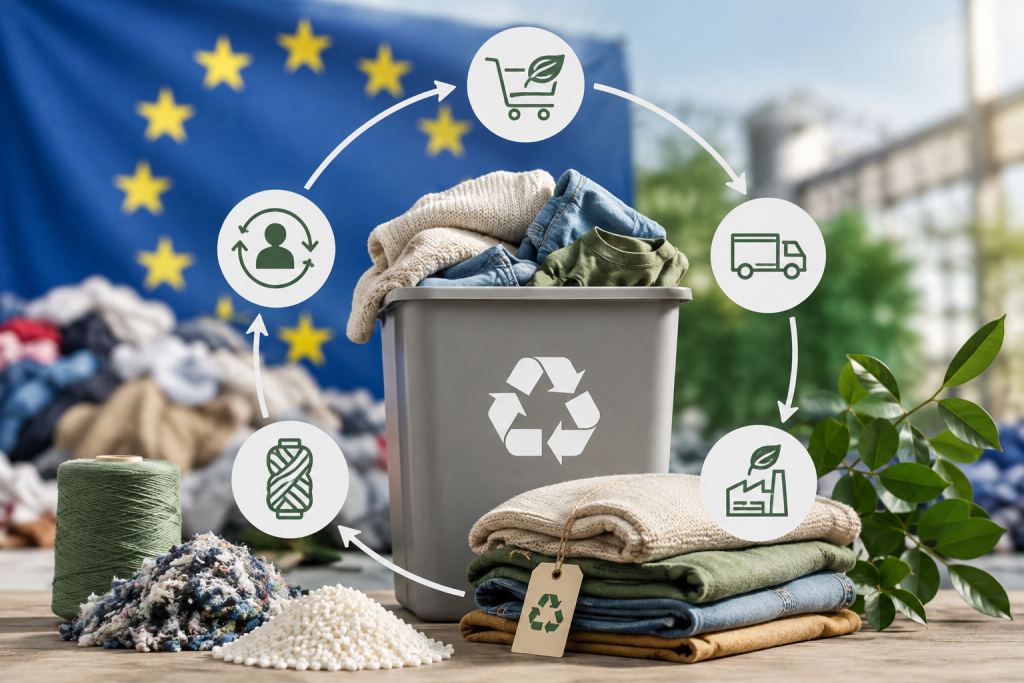
collect → sort → prepare → recycle → process → reintroduce the material.
All of these stages require investment. EPR can help create the economic conditions needed to develop these capacities. The European Commission indicates in particular that producer contributions should help finance separate collection, sorting, reuse and recycling capacities. For recycling companies, this structuring of the sector could therefore represent a significant opportunity.
Separate textile collection becomes a key issue
Separate textile collection is also a central element of the European framework. Member States must strengthen their capacity to collect textiles separately so that they can subsequently be directed towards the most appropriate solutions: reuse, preparation for reuse, recycling or other forms of treatment.
The European regulation also introduces new rules concerning the distinction between used textiles and textile waste, as well as their sorting before certain shipments. This aims in particular to improve the traceability of material flows and limit situations in which textile waste is presented as reusable products when exported.
Why is sorting becoming strategic ?
Not all textiles can follow the same recovery pathway. A garment that is still usable can be directed towards reuse. A product that can no longer be reused may, depending on its composition and condition, be directed towards a recycling stream. This makes sorting and material characterisation particularly important.
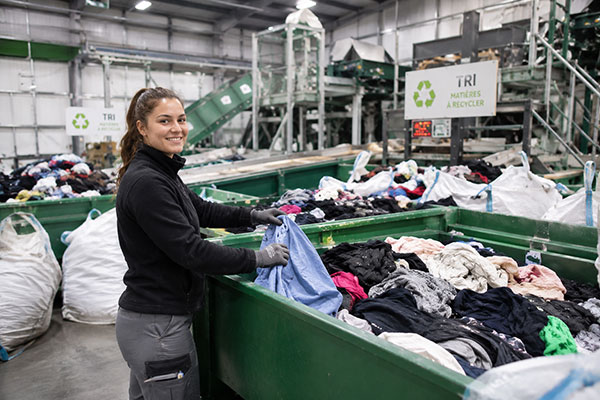
This is also essential for complex textiles. Some products are made from several fibres that can be difficult to separate. This is particularly the case for certain textiles containing polyamide and elastane.
The challenge of complex textiles containing polyamide
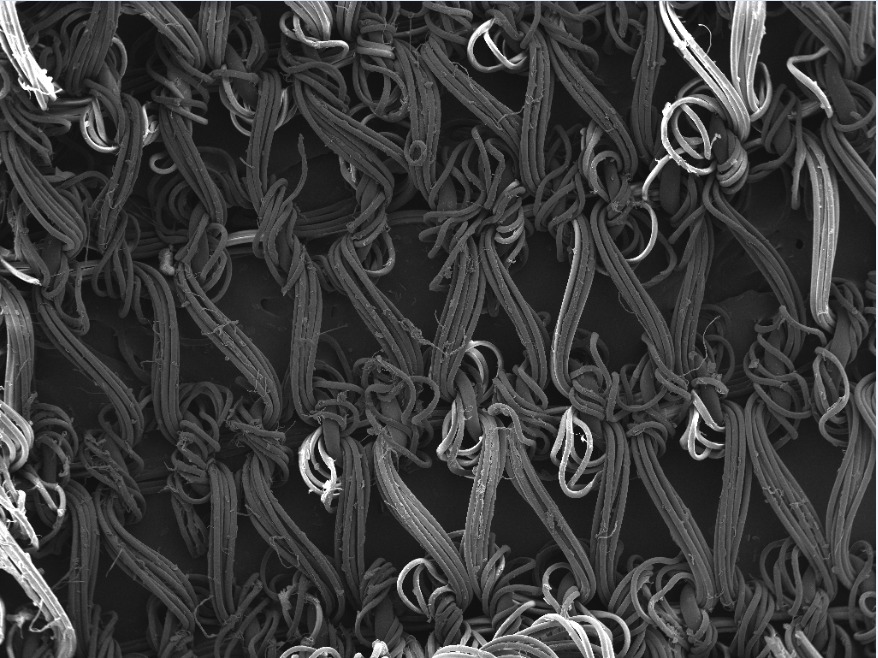
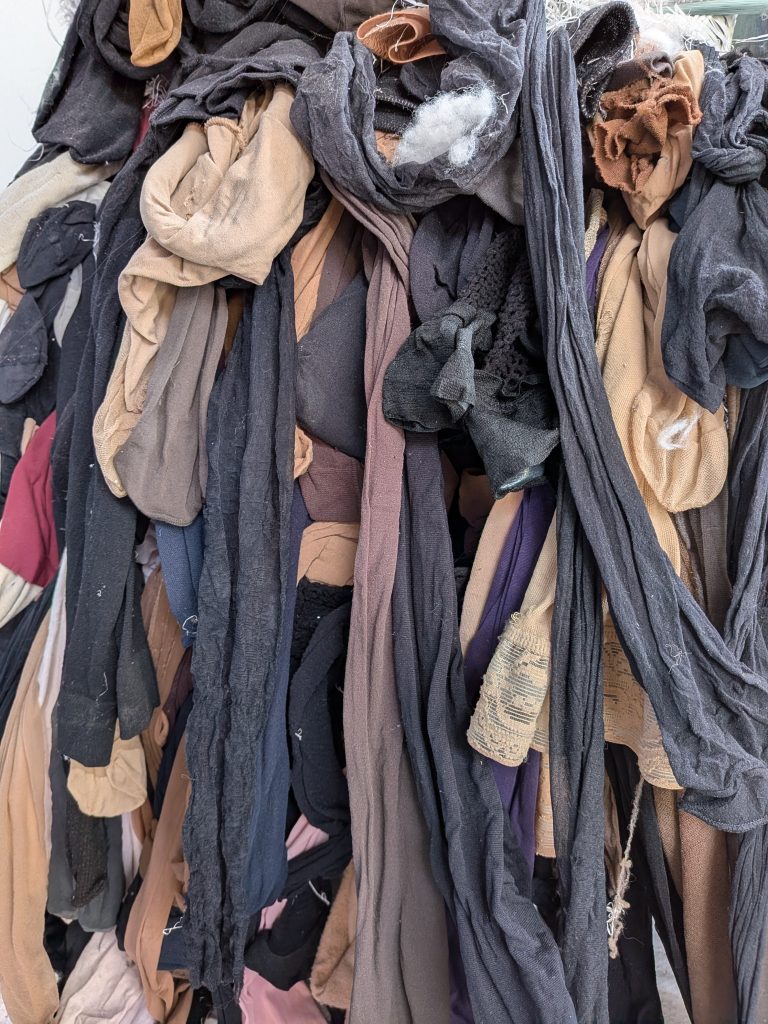
At REC, we are specifically focused on this challenge. Polyamide is used in many textile applications, including tights, lingerie, sportswear, technical textiles and other products. When it is combined with other fibres, recovering it can become particularly complex.
Our technology aims to recover and regenerate the polyamide contained in complex materials in order to produce recycled material for new industrial applications.
Discover REC’s polyamide recycling technology
Can textile EPR accelerate the development of new recycling technologies ?
This is one of the major challenges for the years ahead. Developing new recycling capacity requires significant investment.
Recycling technologies also need sufficient, consistent and properly characterised feedstock to operate at industrial scale. EPR can help create a more favourable economic environment for the development of these capacities, particularly by supporting collection, sorting and recycling infrastructure. The European Commission also highlights that the new rules should foster innovation and strengthen the circularity and competitiveness of the textile sector.
An opportunity to build a truly European textile value chain
EPR should not, however, be viewed solely as a funding mechanism. It can become a tool for structuring the sector.
A circular European textile value chain needs to connect: producers → brands → consumers → collection → sorting → reuse → recycling → industry → new materials.
Each stakeholder plays a different role. For recyclers, one of the key challenges is gaining access to sufficiently high-quality and consistent material flows. For producers and brands, it also means anticipating the end-of-life of their products more effectively.
From regulation to industrialisation
Regulation can create a favourable framework. But it is not enough on its own. To turn European objectives into tangible results, the sector will also need to develop:
- collection infrastructure;
- sorting capacity;
- material preparation facilities;
- recycling technologies;
- industrial capacity;
- outlets for recycled materials;
- effective traceability systems.
This is precisely where industrial startups and Deeptech companies can provide technological solutions.
REC: turning textile polyamide into a new resource
REC’s project is part of this broader transformation. Our objective is to contribute to the development of a value chain capable of recovering the polyamide contained in complex textiles and transforming it into recycled material for new industrial applications.
This approach requires work across the entire chain: feedstock → collection → sorting → preparation → recycling → recycled material → industrial application.
Discover the polyamide feedstocks REC is looking for
What will textile EPR change in Europe ?
The new European regulatory framework establishes common principles around several key areas:
1. Making producers contribute to the management of their products’ end-of-life.
2. Increasing funding for collection, sorting, reuse and recycling capacities.
3. Encouraging ecodesign through eco-modulation of producer contributions.
4. Improving the management and traceability of used textiles and textile waste.
5. Supporting the development of a more circular textile economy.
However, the effectiveness of the framework will largely depend on how it is implemented in each Member State.
What happens next ?
The revised Directive entered into force on 16 October 2025. Member States have 20 months to transpose it into national law and 30 months to establish their EPR schemes for textiles and footwear. The next stage will therefore be particularly important: turning the European framework into operational systems in each country. For the French textile sector, this means closely monitoring how the new rules will be transposed and integrated with the existing French system.
An opportunity to accelerate textile circularity
or REC, this regulatory development is a positive signal. The transition towards a more circular textile economy requires a combination of: an appropriate regulatory framework + investment + infrastructure + technological innovation + cooperation across the value chain.
EPR can help create this framework. The industry must now be able to turn this momentum into concrete collection, sorting, reuse and recycling capacity.
At REC, we are continuing to focus on one specific link in this chain: recycling polyamide contained in complex textiles.
Because a circular European textile value chain can only be built if we are able to transform more waste into new industrial resources.