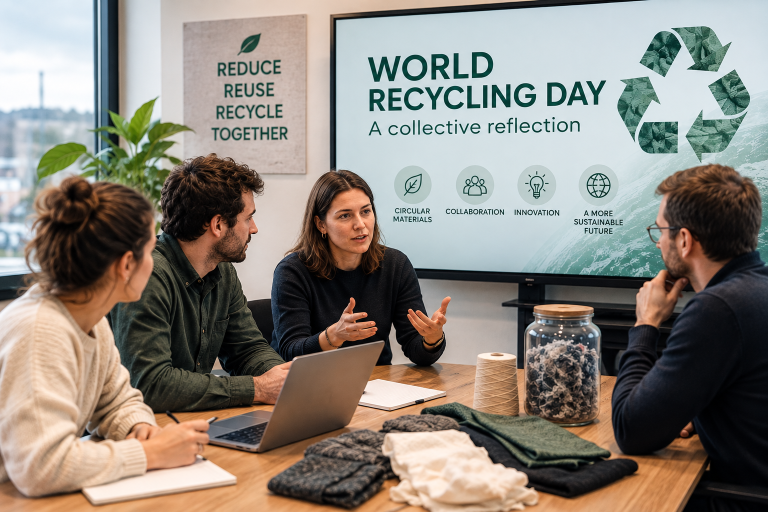
On World Recycling Day, REC looks at the role of recycling in preserving resources and supporting the transition towards a circular economy. In the textile sector, developing new recycling solutions can help transform waste containing polyamide into new resources for industry.
2026 update: This article was originally published under the name Ecollant and has been updated following the company’s name change. Ecollant became REC at the end of 2025, marking a new stage in its industrial development in Joigny.
What is World Recycling Day ?
World Recycling Day is an opportunity to highlight the importance of recycling in preserving resources and transitioning towards a more circular economy. Recycling involves recovering materials from end-of-life products in order to transform them and give them a new use. The objective is to minimise the loss of material value and reduce dependence on virgin resources as much as possible. But for recycling to work effectively on a large scale, the entire value chain needs to be addressed: collect → sort → prepare → recycle → process → reintroduce the material into industry.
This is particularly true for textiles.
Why is textile recycling important ?
Not every end-of-life textile can be recycled using existing technologies. The difficulty depends in particular on its composition, condition and the way its different fibres are assembled. Textiles made from a single material can be relatively straightforward to direct towards certain recycling streams. By contrast, complex textiles made from several fibres represent a much greater technological challenge.
This is particularly true of certain tights, lingerie, sportswear and technical textiles containing polyamide combined with other materials. These products may contain materials with significant industrial value, but their complex structure makes them difficult to recover.
Polyamide recycling: an industrial challenge

Polyamide, also known as nylon, is used in many textile and industrial applications. It can be found in:
- tights and stockings;
- lingerie;
- sportswear;
- technical textiles;
- carpets and rugs;
- certain fishing nets;
- agricultural protection nets;
- various industrial and automotive applications.
When combined with other fibres, recycling polyamide becomes more complex. The challenge is therefore to develop technologies capable of recovering the polyamide contained in these complex materials so that it can be reintroduced into new production cycles.
The challenge of mixed-fibre textiles
Take tights as an example. A pair of tights can be made primarily from polyamide and elastane, with the fibres closely intertwined. This structure provides the product with strength, elasticity and comfort. But it becomes a genuine challenge when the product reaches the end of its useful life. Conventional mechanical recycling processes cannot always efficiently separate these different fibres.
This is one of the technological barriers that REC is working to overcome.
Why are mixed-fibre textiles difficult to recycle?
REC technology: turning waste into a new resource
At REC, our ambition is to help address this challenge. Our technology enables us to recover and regenerate the polyamide contained in complex textiles and materials, producing recycled material for new industrial applications. The objective is to transform materials that are currently difficult to recover into new industrial resources. This approach follows a circular economy model:
textile waste → polyamide recovery → regeneration → recycled polyamide granules → new industrial application.
It is therefore not simply about managing waste, but about preserving the value of a material that has already been produced.
Why is collection essential to recycling ?
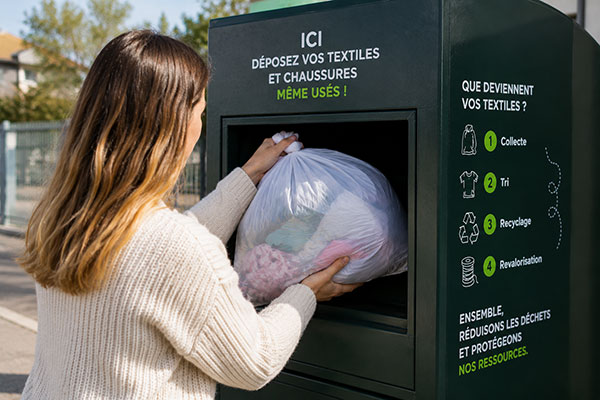
Recycling begins before the textile even enters our technology. We first need to identify, collect and sort textiles containing polyamide. Collection is therefore the first link in the recovery chain.
At REC, we work with both pre-consumer and post-consumer feedstocks to build secondary raw material streams adapted to the requirements of industrial recycling.
Post-consumer feedstocks may include textiles that have been used and have reached the end of their useful life.
Pre-consumer feedstocks include production offcuts, defects, surplus materials or dormant stocks generated during industrial production.
Discover how REC collects textiles containing polyamide
Recycling to preserve resources
One of the main benefits of recycling is the ability to reuse material that already exists within our economy.
For polyamide, this means progressively reducing dependence on the virgin resources used to produce new materials. This approach is particularly important as manufacturers seek to secure their supplies and reduce the environmental impact of their activities.
Recycling can therefore contribute to several objectives simultaneously:
- reducing waste;
- preserving resources;
- developing secondary raw materials;
- strengthening the circularity of value chains;
- creating new industrial sectors;
- reducing dependence on virgin materials.
Recycling cannot work alone
A circular economy does not rely on recycling alone. Reuse, repair, eco-design, second-hand markets, collection, sorting and recycling all need to work together.
When a garment can still be worn, repaired or reused, extending its useful life remains a priority. When it genuinely reaches the end of its useful life and can no longer be used under suitable conditions, recovering its materials becomes essential.
It is this complementarity that makes it possible to build a truly circular economy.
A transformation that requires the entire industry
The development of textile recycling cannot be achieved by a single stakeholder. It requires cooperation throughout the value chain: consumers → brands → manufacturers → collectors → sorters → recyclers → spinners → industrial users.
Each stakeholder has a specific role to play.
At REC, we work in particular with collection and sorting operators to better characterise feedstocks and prepare materials for recycling. This cooperation is essential to developing an industrial polyamide recycling value chain.
Turning today’s waste into tomorrow’s raw material
This is precisely the vision behind REC. Founded in 2019 in Auxerre under the name Ecollant, the company became REC in 2026 and is now pursuing its industrial development in Joigny.
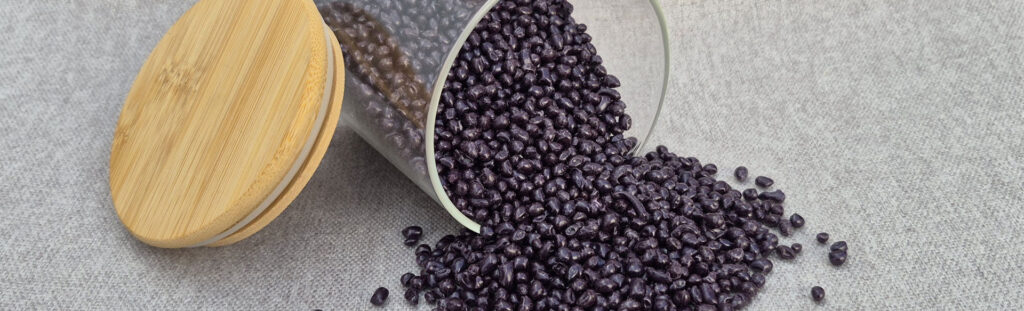
Our ambition is to develop an industrial value chain capable of transforming complex waste containing polyamide into recycled raw materials for industry. This approach combines: technological innovation + collection + industrialisation + circular economy.
Discover REC’s ambition for polyamide recycling
World Recycling Day: a reminder, but above all a commitment
World Recycling Day is an opportunity to remember that the transition towards a circular economy does not depend solely on consumers. It also requires the development of industrial solutions capable of recovering materials that remain difficult to recycle today. In the textile sector, the challenges are numerous, but so are the opportunities.
At REC, we believe that waste containing polyamide does not necessarily have to represent an end of life.
It can become a new industrial resource. This conviction guides our work every day.
Recycling means preserving the value of materials that have already been produced. Building a circular economy means learning how to make those materials circulate again. ♻️