Can industrial innovation provide concrete solutions to the ecological transition? For REC, the answer lies in particular in developing new recycling technologies capable of recovering value from complex textiles containing polyamide. A look back at our participation in the We Impact podcast and at the challenges involved in developing a more circular textile industry.
2026 update: This article, originally published under the name Ecollant, has been updated following the company’s name change. Ecollant became REC at the end of 2025 and is now continuing its industrial development in Joigny.
Industrial innovation serving the ecological transition
The environmental challenges facing industry are numerous: reducing resource consumption, cutting waste, decarbonising activities, developing new materials and transforming production models. In response to these challenges, industrial innovation can provide concrete solutions. But developing a technology is not enough.
To have a real impact, an innovation must be deployed, industrialised and integrated into an existing value chain, or contribute to creating a new one. This is precisely the challenge at the heart of REC’s project.
REC featured on the We Impact podcast
In 2025, Agathe Rouzaud took part in the We Impact by G.A.C. Group podcast to present our project, our Deeptech technology and our vision of the circular economy. It was an opportunity to look back at several years of development focused on one objective: developing an industrial solution capable of recovering and regenerating the polyamide contained in complex textiles.
The project lies at the crossroads of several sectors:
- industry;
- textiles;
- chemistry;
- materials;
- recycling;
- circular economy;
- Deeptech.
This combination is also what makes the project so complex.
Why recycle complex textiles ?
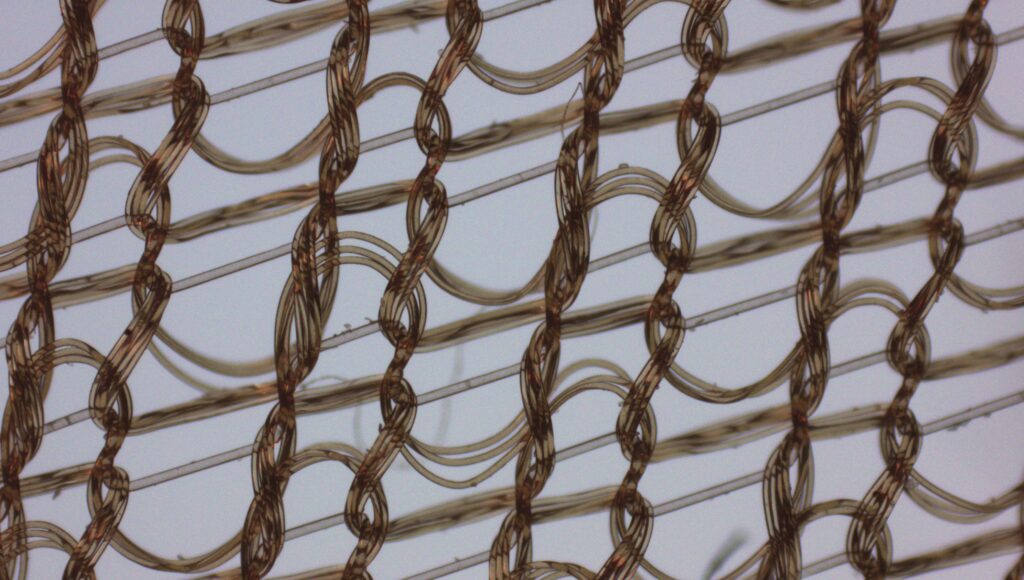
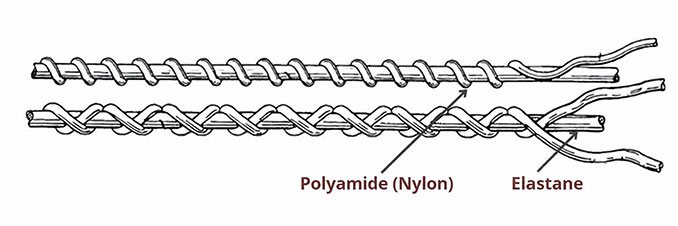
Not all textiles are equally easy to recycle. Some products are made up of several closely intertwined fibres, making their separation and recovery more difficult.
Textiles containing polyamide blended with other fibres, particularly elastane, are a good example of this challenge. Tights are particularly representative of these complex textiles. Their structure provides the properties required during use, but also makes fibre separation difficult when the product reaches the end of its life.
This is the type of technological barrier that REC is working to overcome.
Understanding the challenge of recycling complex textiles
From used textile materials to a new resource
The objective of the project is to move beyond considering certain end-of-life textiles solely as waste. They can also represent sources of valuable materials. Our approach consists of recovering the polyamide contained in these complex materials in order to regenerate it and produce recycled material for new industrial applications.
The idea is therefore to create a new loop: end-of-life textile → polyamide recovery → regeneration → recycled material → new application.
This approach contributes to the development of a more circular economy.
A local value chain to address an industrial challenge
Our ambition is also to contribute to building a local and industrial value chain. REC’s establishment in Joigny, in the Yonne department, reflects this ambition to bring together:
- textile feedstocks;
- material preparation activities;
- industrial expertise;
- infrastructure;
- local stakeholders;
- industrial outlets.
This approach helps embed textile recycling within a broader dynamic of regional reindustrialisation and the circular economy.
Discover REC’s industrial development
Innovation cannot move forward alone
Developing an industrial technology requires an ecosystem. At REC, the project relies on interactions with many different stakeholders:
collectors, sorting operators, textile manufacturers, spinners, technical centres, laboratories, institutions, investors and industrial partners.
These collaborations help us better understand market needs, feedstock characteristics, industrial constraints and potential applications for recycled material. The ecological transition is therefore also a matter of industrial cooperation.
From Deeptech to industry
An industrial Deeptech company faces a dual challenge.
The first is technological:
Is it possible to overcome the scientific or technical barrier?
The second is industrial:
Is it possible to transform this solution into a robust, reproducible and economically viable process?
At REC, we are working precisely along this path. The objective is not simply to demonstrate that a material can be recovered. It is to progressively build an industrial capacity for polyamide recycling.
The We Impact podcast: sharing our vision of industrial innovation and the ecological transition
Our participation in the We Impact podcast gave us the opportunity to discuss this journey and explain why we believe that industrial innovation can make a concrete contribution to the ecological transition.
We shared our vision of a more circular textile industry, in which today’s waste can become tomorrow’s industrial resources.
🎧 Listen to the We Impact podcast
Building the circular textile industry of tomorrow
The transformation of the textile industry will not rely on a single solution. It will likely require a combination of approaches: eco-design + reduced resource consumption + reuse + repair + collection + sorting + recycling + new materials.
Recycling technologies have a role to play when products reach the end of their useful life and their materials can still be recovered. For REC, the challenge is to contribute to this transformation by developing an industrial solution for complex textiles containing polyamide.
Our conviction is simple: technological innovation creates new possibilities, but scaling up and integrating it into a value chain are what make industrial impact possible.