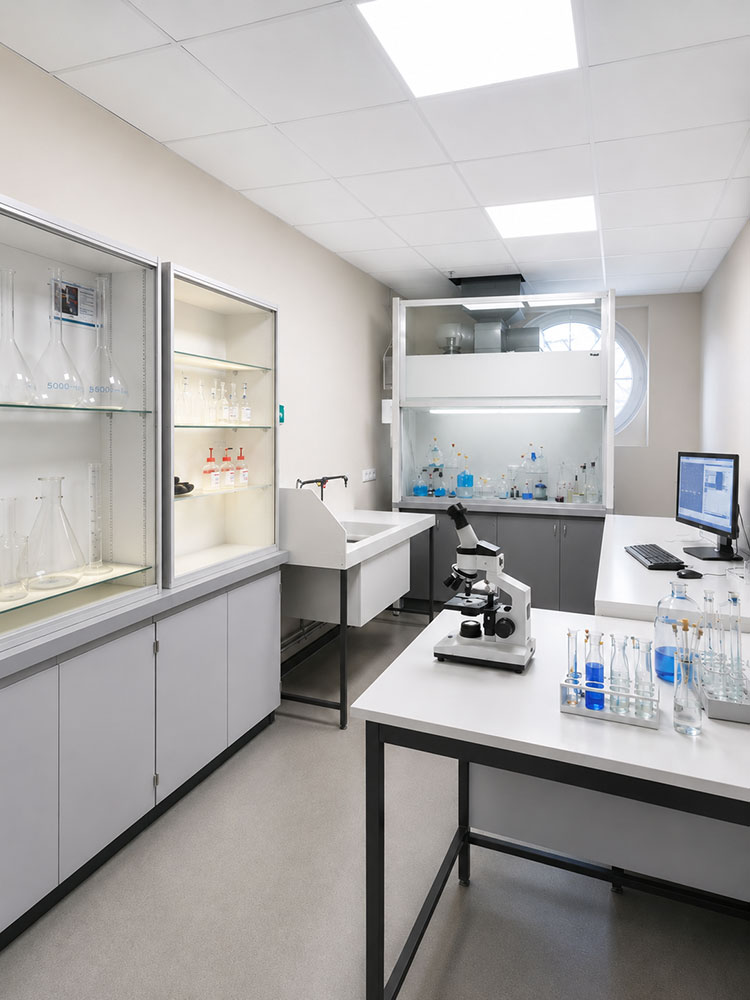
From research to industry, every step matters. With its new laboratory located at its Joigny site, REC is taking another major step in the development and industrialisation of its polyamide recycling technology.
After several years of research and development initiated under the name Ecollant, REC is now pursuing its ambition: to recover the polyamide contained in complex textiles and give it a new industrial life.
The Joigny laboratory is an essential part of this journey. It enables our teams to continue their research, conduct experiments, characterise materials and optimise the process, with a clear objective: to prepare for and secure the transition to industrial scale.
From laboratory to industry: taking the scale-up challenge
Developing a technology in the laboratory is a first step. Transforming it into a robust, reproducible and economically viable industrial process is another.
For an industrial Deeptech company like REC, scaling up requires a precise understanding of the materials being processed, control of the different stages of the process and the ability to reproduce laboratory performance on increasingly larger volumes.
This is precisely the role of REC’s new laboratory in Joigny.
It enables us to work as closely as possible with the industrial process and provide concrete answers to the questions that arise at every stage of development:
Research → experimentation → characterisation → optimisation → scale-up → industrialisation
This gradual approach helps reduce uncertainties and secure the transition from a technological innovation to a genuine industrial solution.
Discover how the industrial pilot helps prepare for scaling up polyamide recycling
Why a laboratory dedicated to polyamide recycling ?
Recycling a material is not simply a matter of applying a single, standard recipe.
Textile materials can have very different compositions, structures and levels of contamination. The behaviour of polyamide can also vary depending on its origin and the fibres with which it is combined.
This diversity is particularly important when dealing with complex textiles.
REC’s laboratory enables us to:
- test different treatment conditions;
- characterise incoming materials;
- study their behaviour throughout the process;
- analyse recovered materials;
- measure and control their characteristics;
- optimise process parameters;
- compare different feedstocks;
- identify technological limitations;
- prepare for future scale-up stages.
The objective is to achieve a robust, reproducible process capable of adapting to the diversity of polyamide feedstocks.
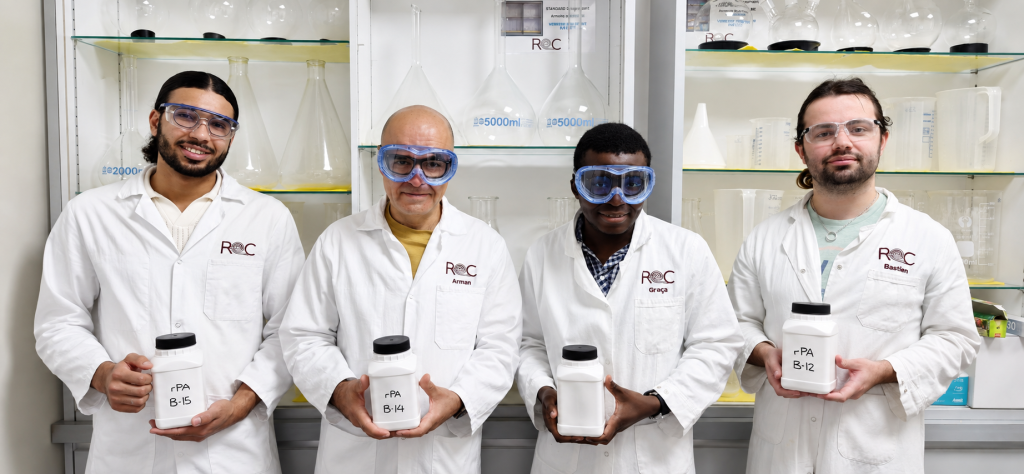
From left to right in this photo, part of the REC team:
- Jilani Ben Mohamed Khiat – Process R&D Apprentice
- Arman Samii – Director – Industrial Project Manager
- Graça Manuel Marcos – Process Manager
- Bastien Morand – Laboratory Manager
The challenge: recycling complex textiles
Not all textiles present the same challenges when they reach the end of their life.
When a product is made from a single material, certain recycling solutions may be easier to consider. The situation becomes much more complex when several fibres are intimately combined.
This is particularly the case with textiles containing both polyamide and elastane.
Tights are a prime example. Their composition gives them the properties essential for their use: elasticity, strength, comfort and fineness. But this same combination of fibres makes them particularly complex to recycle at the end of their life.
The same applies to certain lingerie products, sportswear and technical textiles.
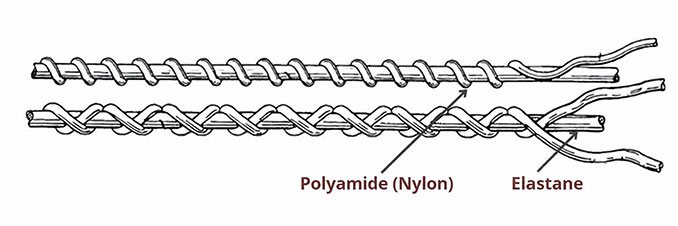
This is the type of technological challenge on which REC focuses its expertise.
Discover why textiles containing polyamide are difficult to recycle
Recovering and regenerating polyamide without depolymerising it
REC’s ambition is to develop a solution capable of recovering and regenerating the polyamide contained in mixed-fibre materials.
REC’s technology is designed to separate polyamide from other fibres without depolymerising the polymer, in order to preserve the value and intrinsic properties of the material.
The recovered polyamide can then be transformed into recycled material intended for new industrial applications, particularly in the form of flakes and/or recycled polyamide pellets.
The challenge is significant: rather than considering a complex end-of-life textile simply as waste, the aim is to recover the high-value material it contains and reintroduce it into a new value chain.
Complex end-of-life textile → polyamide recovery → regeneration → recycled material → new industrial application
Find out more about REC’s polyamide recycling technology
The laboratory: a tool supporting industrialisation
The new laboratory is therefore not an end in itself. It is a tool supporting industrialisation.
As volumes increase, new challenges emerge:
- process reproducibility;
- performance stability;
- quality and consistency of the material produced;
- equipment sizing;
- resource consumption;
- operational safety;
- material flow management;
- operating costs;
- adaptation to different feedstocks;
- compliance with regulatory and industrial requirements.
A process that performs well on a few grams or kilograms must be able to maintain its performance as volumes increase.
This is the essence of industrial scale-up.
Looking back at the scale-up work that paved the way for this new stage of development
The laboratory enables us to understand and learn.
The pilot enables us to validate and size the process.
The plant must enable us to produce reliably, consistently and competitively.
A laboratory directly located at the Joigny site
Locating the laboratory at the Joigny industrial site, in the Yonne department, offers a major strategic advantage.
It brings the R&D teams closer to the industrial realities they need to address.
Experiments can therefore be carried out with a concrete understanding of production constraints, material flows and future operating conditions.
This proximity between research, experimentation and industry should enable REC to progressively accelerate the maturation of its technology and prepare for the next stages of its industrial development.
It also contributes to a broader ambition: supporting industrial redevelopment and the development of the circular economy in the Bourgogne-Franche-Comté region, by creating new local industrial capabilities in recycling.
Building not only a technology, but also an industry
Industrialising polyamide recycling is not only about developing a high-performance process.
It also means building the entire value chain that will enable this technology to operate at scale.
This requires:
- sufficiently large feedstocks;
- identified and collected material streams;
- sorted and prepared textiles;
- suitable industrial capacities;
- high-performance recycling technologies;
- outlets for recycled materials;
- industrial partners capable of reintegrating these materials into their own products.
The laboratory directly contributes to building this industry.
By improving our understanding of different feedstocks and their behaviour, it helps REC progressively adapt and optimise its process to the realities of the available materials.
The challenge is therefore not simply to recycle more. It is to create the conditions that will enable recycled polyamide to sustainably regain its place in industry.
A new milestone in REC’s ambition
With this new laboratory in Joigny, REC is taking another major step in its development. After several years dedicated to research and development, the company is now entering a phase in which the priority is to turn technological innovation into industrial capacity.
The laboratory plays a central role in this transition: experimenting, characterising, understanding, optimising, measuring and preparing for scale-up. This approach supports a broader ambition: to help establish a new recycling industry capable of transforming complex textiles into recycled raw materials for industry.
Because the true challenge of the circular economy is not simply to give products a second life. It is to enable the materials they contain to remain in the industrial cycle for as long as possible.
At Joigny, this is precisely what REC is working towards.
From complex end-of-life textiles to the recycled polyamide of tomorrow, every step matters. ♻️