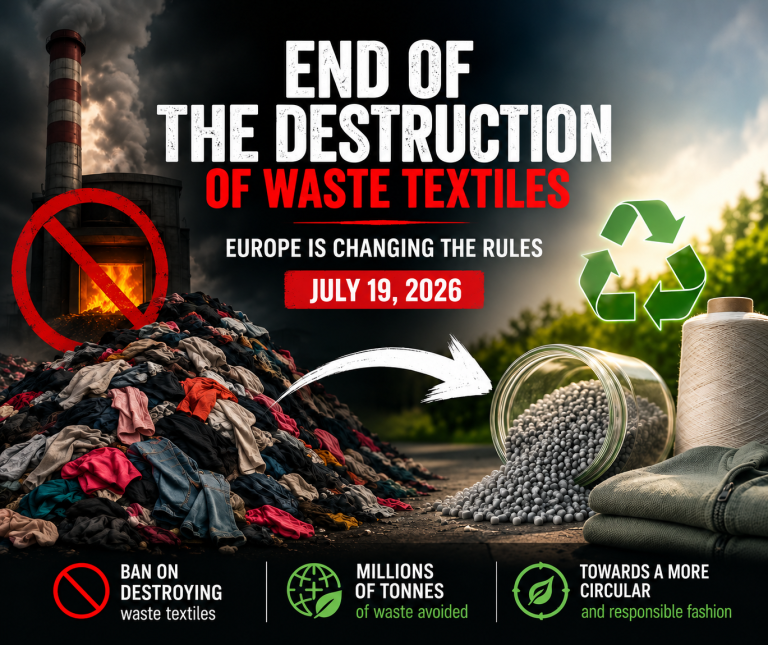

Since 1 September 2026, France has taken a further step in the fight against ultra-fast fashion. The Anti-Ultra-Fast-Fashion Act, aimed at reducing the environmental impact of the textile industry, notably introduces a penalty on products associated with ultra-fast fashion.
Behind this measure lies a clear objective: to reduce textile overproduction and overconsumption, encourage more durable products, and strengthen reuse and recycling.
For REC, this development above all marks a paradigm shift: recycling should no longer be considered the final stage in a garment’s life, but rather an essential link in a truly circular textile economy.
New regulations to tackle ultra-fast fashion
The French law aimed at reducing the environmental impact of the textile industry was enacted on 8 July 2026.
It specifically targets ultra-fast-fashion practices, characterised by an extremely large number of products, very rapid collection turnover, particularly low prices and limited incentives for repair and reuse.
Since 1 September 2026, the products concerned have been subject to an adjustment of their eco-contribution. The penalty can reach 50% of the product price, subject to a €12 limit in 2026, with a progressive increase planned up to €19.50 in 2030.
The objective is to change the economic model: producing ever more products at ever lower prices should no longer come without environmental consequences.
This measure comes at a time when the volume of textiles placed on the French market continues to increase. In 2025, 3.6 billion new items were sold in France, representing a 1.5% increase compared with 2024.
Source: Refashion, 2025 Annual Barometer, published in June 2026.
What exactly changes with the Anti-Ultra-Fast-Fashion Act from 1 September 2026?
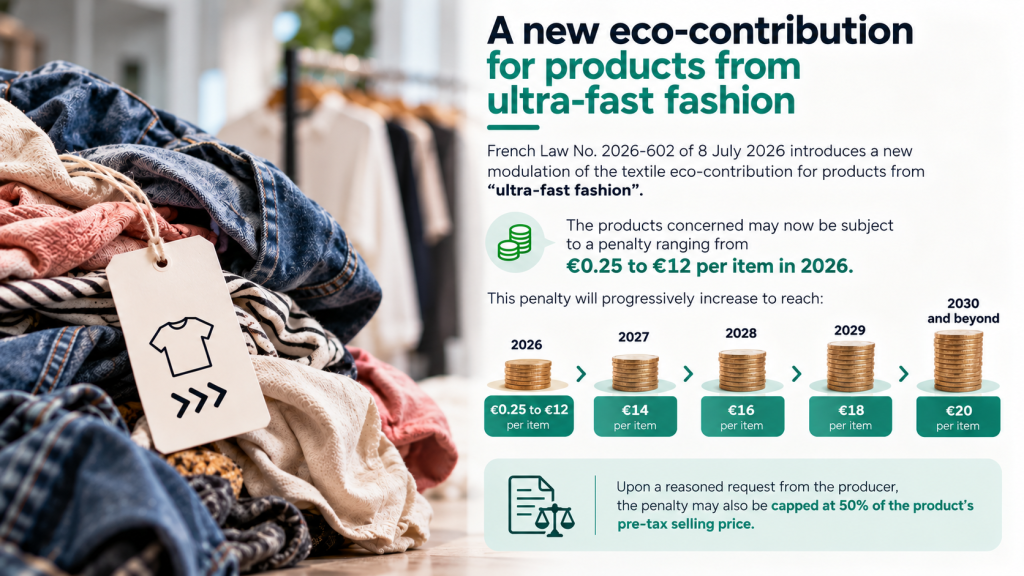
French Law No. 2026-602 of 8 July 2026, aimed at reducing the environmental impact of the textile industry, introduces a new mechanism for adjusting the textile eco-contribution for products associated with “ultra-fast fashion”.
This category notably covers models characterised by the placing on the market of a high number of new product references and limited incentives to repair, with the precise criteria being defined by decree.
Since 1 September 2026, the products concerned may therefore be subject to a penalty ranging from €0.25 to €12 per item. This amount will progressively increase: up to €14 in 2027, €16 in 2028, €18 in 2029 and €20 from 2030.
The law also provides that, upon a reasoned request from the producer, the premium or penalty may be capped at 50% of the product’s pre-tax selling price. For example, for a garment sold for €10 excluding VAT, the penalty could not exceed €5 under this cap; for a garment sold for €5 excluding VAT, it could be limited to €2.50. Conversely, for a garment sold for €30 excluding VAT, the 50% cap would be €15, but the 2026 regulatory ceiling would remain €12.
The objective is clear: to make an economic model based on very high volumes, very low prices and extremely rapid collection turnover less attractive.
For REC, this mechanism is particularly significant because the law goes beyond penalising products: it also provides for a share of the contributions paid by producers to be used by producer responsibility organisations to finance collection, sorting, reuse, preparation for reuse and recycling infrastructure within France.
Read also: European textile EPR: what the new rules mean for textile recycling
Why is the Anti-Ultra-Fast-Fashion Act important for the entire textile industry?
The issue of ultra-fast fashion is not limited to garment production. Every garment produced can eventually become waste. When volumes increase significantly, the volumes requiring collection, sorting, reuse and recycling also increase. Yet the French sector is already under considerable pressure.
Read also: How to structure a local textile recycling value chain
The French Government recognised in 2026 that the growth of ultra-fast fashion had led to a significant increase in the volumes placed on the market, while traditional export outlets had contracted. Collection and sorting operators are therefore facing a major economic imbalance.
Read also: Ban on destroying unsold textiles in Europe: what the new regulations change
The question is therefore no longer simply: “How can we produce garments with less impact?”
It is also: “What do we do with the millions of garments that reach the end of their lives?”
This is precisely where industrial recycling takes on its full meaning.
Read also: World Recycling Day: why textile recycling is essential to the circular economy
At REC, we believe textile waste should become a resource
At REC, we fully support the objective behind this regulatory development: progressively moving away from a linear model in which raw materials are extracted, transformed into garments, consumed and then discarded.
Our vision is different. An end-of-life textile is not necessarily waste. Above all, it is a raw material.
Our role is to identify textiles that can be recovered, direct them towards the appropriate value chains and develop recycling solutions that enable materials to be reintroduced into a new production loop.
This approach is particularly important for synthetic and technical materials, some of which can retain significant material value when properly identified and directed to the appropriate recovery pathway.
Read also: Polyamide recycling: discover REC in video
Recycling must become a genuine industrial outlet
The Anti-Ultra-Fast-Fashion Act sends a strong signal to textile industry stakeholders. But penalising overproduction models is not enough. We must also build the industrial capacity required to process textiles that have already been produced.
This is one of the major challenges for REC in the coming years.
Read also: New laboratory in Joigny: REC strengthens its R&D to industrialise polyamide recycling
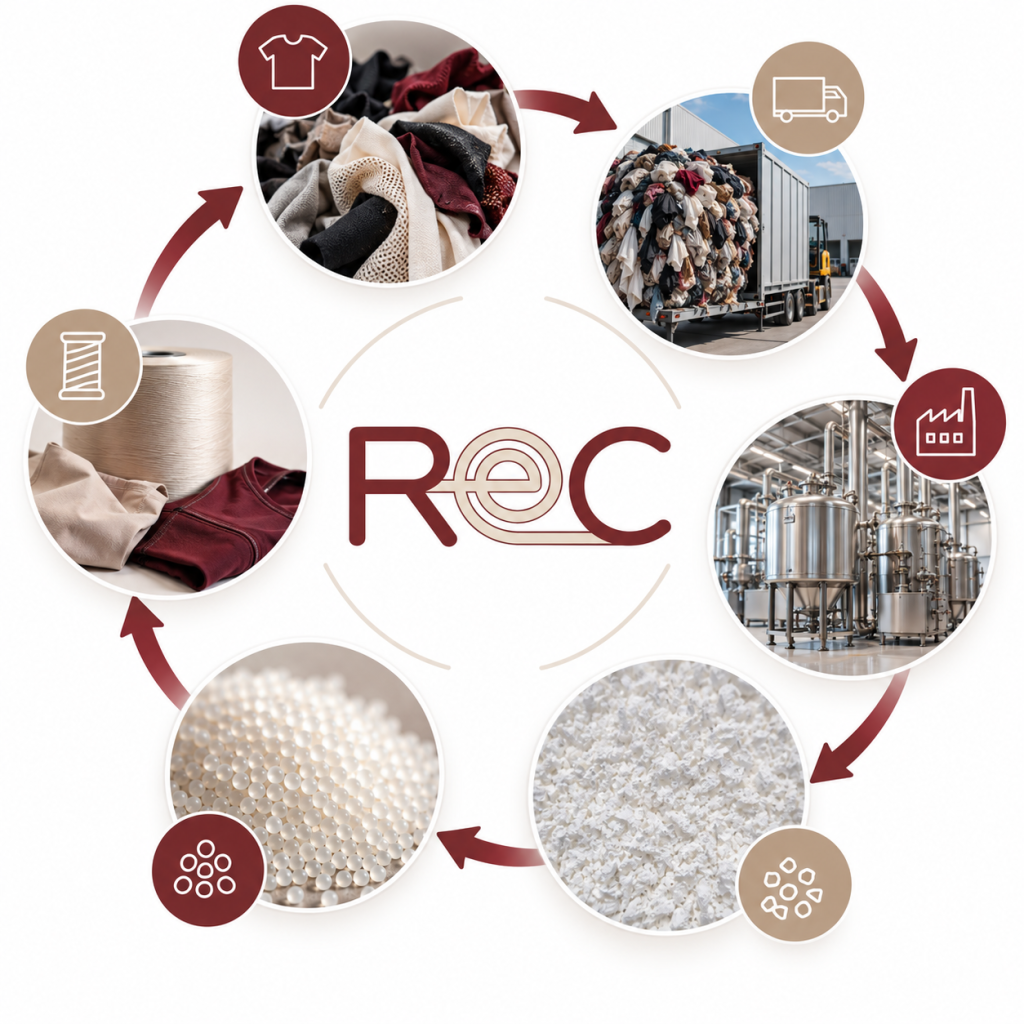
The value chain must progressively be able to move from: waste → sorting → recycled material → new industrial application
This transformation requires infrastructure, technologies, partnerships between industry stakeholders and, above all, outlets for recycled materials. The French Government has also identified the development of a French recycling industry as one of the priorities for restructuring the textile EPR sector.
Read also: Industrial innovation and textile recycling: when DeepTech addresses environmental challenges
An Anti-Ultra-Fast-Fashion Act that could accelerate textile recycling
For REC, the introduction of the penalty represents an important development on several levels.
Less pressure on prices, greater value placed on materials
For a long time, the extremely low price of certain garments contributed to normalising their disposable nature. The penalty progressively reintroduces part of the environmental cost into the economic equation. This may encourage brands and consumers to move towards more durable, repairable and recyclable products.
A growing need to develop recycling solutions
The law explicitly encourages repair, reuse and recycling. For REC, this means that demand for solutions capable of transforming textiles into new raw materials could gradually increase.
Our ambition is precisely to contribute to this transformation by developing industrial solutions that give textile materials a second life.
Recyclability must be considered at the design stage
Recycling cannot be effective if products are designed without considering their end of life. Textile composition, fibre blends, accessories, treatments and assembly methods all influence a product’s recyclability. The new regulations therefore reinforce a conviction held by REC:
The best textile waste is material that can be recovered and reused.
From end of life to new raw material
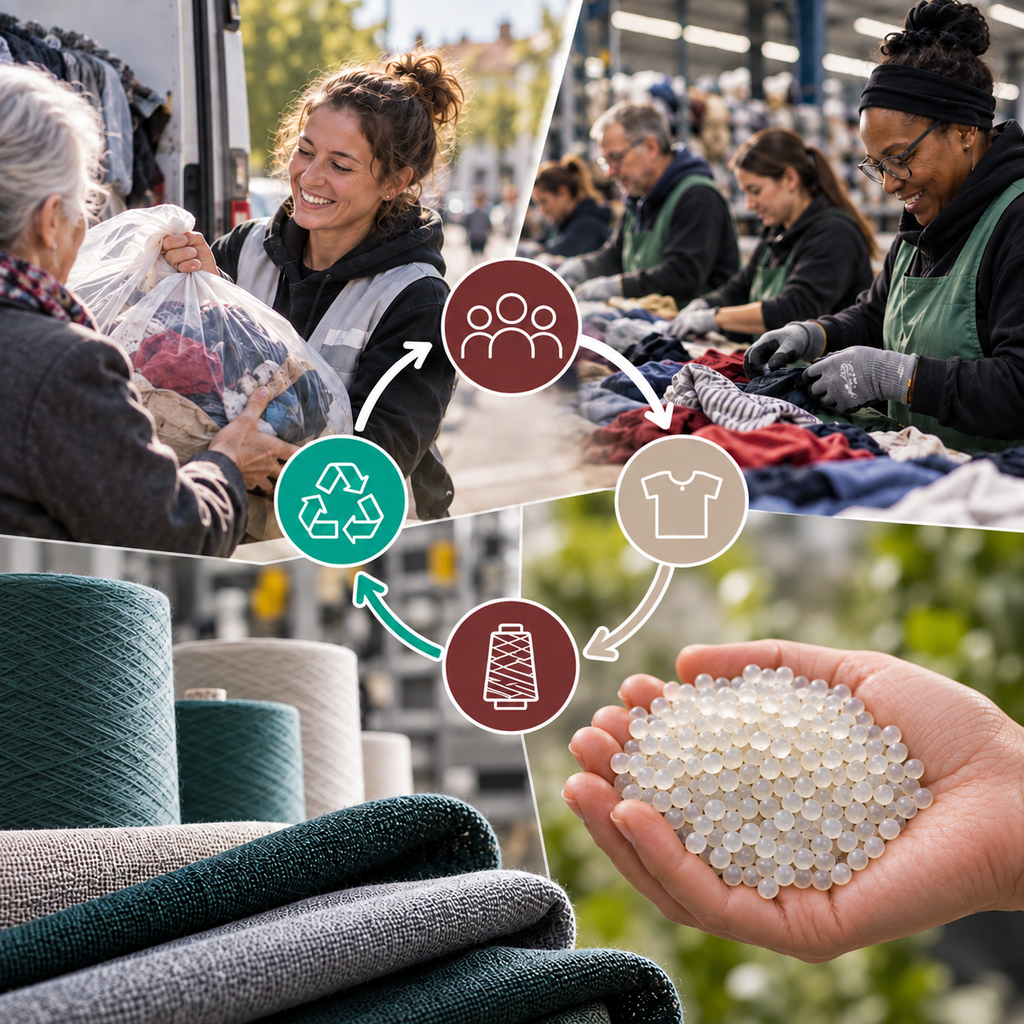
For REC, the circular textile economy should not stop at sorting. A collected garment should follow a pathway suited to its composition and condition:
Collection → Sorting → Reuse where possible → Recycling → Recycled material → New production
This approach helps reduce dependence on virgin materials and retain more value within the value chain. This is particularly important at a time when France is seeking to strengthen its recycling capacity and reduce the economic vulnerabilities of the textile sector.

And what comes next?
The entry into force of the Anti-Ultra-Fast-Fashion Act will not, on its own, transform the entire textile industry. But it represents a major economic and regulatory signal.
It is progressively encouraging industry stakeholders to ask new questions:
- How many garments do we produce?
- How long do they last?
- Can they be repaired?
- Can they be reused?
- Can they be recycled?
- What happens to their materials when they can no longer be used?
- Is there an industrial value chain capable of giving them a new life?
At REC, we are convinced that answering these questions requires a high-performing French textile recycling industry, capable of transforming existing material streams into new resources.
The fight against ultra-fast fashion should therefore not only lead to producing less. It should also lead us to make better use of what has already been produced. And this is precisely where recycling has a role to play.
Our ambition: turning textiles into industrial resources for tomorrow
In response to regulatory developments and the growing challenges facing the textile industry, REC continues to pursue its objective: developing recycling solutions capable of transforming complex end-of-life textiles — made from blends of several materials — containing polyamide into new resources for industry.
Because a truly circular economy is not simply about reducing waste.
It is about turning today’s waste into tomorrow’s raw material.